


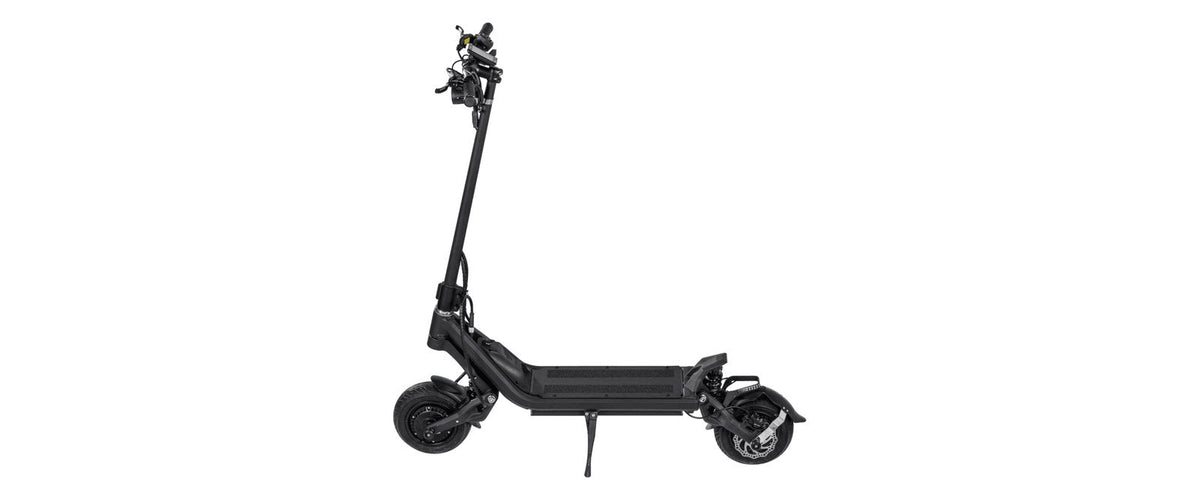
The battery is the only real difference. The Nami Klima Max carries a 60V 30Ah LG pack rated for up to 62 miles, against the standard Klima's 60V 25Ah pack and 50 miles; motors, top speed (42 mph), suspension and brakes are the same, and on Nami's published figures the Max weighs just 0.7 kg (about 1.5 lb) more. The Klima sells in the $1,750–$2,250 band and the Klima Max in the $2,200–$2,800 band, so buy the Max if your rides run long and the Klima if they don't.
Both are dual-motor electric scooters built on the same one-piece aluminum frame, and Nami is one of the brands our customers buy most. We ship both free to the lower 48 and service them in our shops. Here is how they compare on Nami's published figures, and how to choose.
Klima vs Klima Max at a glance
| Nami Klima | Nami Klima Max | |
|---|---|---|
| Battery | 60V 25Ah, 1,500 Wh | 60V 30Ah, LG 21700 cells, 1,800 Wh |
| Rated range | Up to 50 miles | Up to 62 miles |
| Top speed | Up to 42 mph | Up to 42 mph |
| Motors | Two 1000W brushless hub motors, 4,800W peak, two 40A sine-wave controllers | |
| Suspension | KKE hydraulic coil shocks front and rear, rebound adjustable | |
| Brakes | Logan 2-piston hydraulic discs, front and rear | Logan hydraulic discs, 160 mm rotors, front and rear |
| Tires | Tubeless CST: 11-inch on Nami's spec sheet, 10-inch on our product pages; hybrid or off-road tires available | |
| Weight | 37.6 kg (about 83 lb), Nami's published figure (EU listing) | 38.3 kg (about 84 lb), Nami's published figure (EU listing) |
| Max rider | 243 lb (110 kg, Nami) | 243 lb (110 kg, Nami) |
| Charging | 7 to 8 hours with the included 5A charger | |
| Water rating | IP55 | |
| Price band* | $1,750–$2,250 | $2,200–$2,800 |
*Prices change often: the product pages show today's price. Specs are Nami's published ratings as listed on our product pages; weight, maximum rider weight, tire size and the Klima Max's 1,800 Wh are from Nami's own spec sheets on nami-electric.com (EU listing). Range depends on speed, rider weight, hills and temperature.
What is the difference between the Nami Klima and Klima Max?
The pack. The Klima Max swaps the Klima's 60V 25Ah battery for a 60V 30Ah pack built on LG 21700 cells. That's 20 percent more amp-hours at the same voltage, and Nami's range rating goes from 50 to 62 miles to match.
Everything you feel on the road is shared: the same pair of 1000W hub motors with a 4,800W peak, the same KKE hydraulic coil shocks with rebound adjustment, the same tubeless CST tires, the same quick-release stem clamp and the same thumb throttle and smart display with ride modes and NFC. Both have a 2000-lumen headlight and side LED strips with turn signals.
Our two product pages describe the brakes slightly differently: Logan 2-piston full-hydraulic discs on the Klima, and Logan hydraulic discs on 160 mm rotors on the Klima Max. Either way, both stop with hydraulic discs at both wheels.
How far does each one go on a charge?
Nami rates the Klima for up to 50 miles and the Klima Max for up to 62 miles. Our Klima page also gives a real-world figure of about 40 miles from the 50-mile rating, which is a fair rule of thumb for both: expect roughly four-fifths of the rated range in mixed riding, and less if you ride flat out, carry a heavy load, climb a lot or ride in the cold.
Both refill in 7 to 8 hours on the included 5A charger, so either one is an overnight charge. The Max's bigger pack doesn't change the charger or the charge time in Nami's figures.
For more on what shortens range and how packs age, see how long electric scooter batteries last, and for the longest-range models across brands, our best long-range electric scooters.

How fast are the Klima and Klima Max?
The same: up to 42 mph, from two 1000W hub motors peaking at 4,800W together. Ride modes below that are set from the display. Our Klima page lists Nami's acceleration figures as 0 to 15 mph in 2.0 seconds, 0 to 25 mph in 4.0 seconds and 0 to 35 mph in 6.7 seconds; the Max uses the same drivetrain at almost the same weight.
That is far more than most streets allow. Many states and cities cap electric scooter speeds well below 42 mph, and New York City allows electric scooters up to 15 mph, so check your local limits before you ride. Our guides to California and Florida electric scooter laws show how much the rules vary.
Is the Klima Max heavier than the Klima?
Slightly. Nami's published figures (EU listing) put the Klima at 37.6 kg (about 83 lb) and the Klima Max at 38.3 kg (about 84 lb), so the bigger pack adds about 1.5 lb. Nami rates both for riders up to 110 kg (243 lb). At around 83 to 84 lb, either one fits in a car trunk or an elevator, but it isn't something to carry up several flights of stairs every day. If carrying is part of your commute, look at our lightest electric scooters instead.
How much do the Klima and Klima Max cost?
The Klima sells in the $1,750–$2,250 band and the Klima Max in the $2,200–$2,800 band. Prices move often, so see today's price on the Klima and Klima Max pages.
- Shipping: free standard shipping to the lower 48 states. See our shipping policy.
- New York City: models over 20 mph aren't sold or shipped to New York City addresses, so neither Klima ships to a New York City address.
- Paying over time: pay in four with Klarna or Affirm at checkout. See financing.
- Warranty: one year with Wilson's against manufacturing defects, and we manage the claim with Nami.
Which should you buy?
Buy the Klima Max if your rides run long
If your round trip is more than about 25 to 30 miles, or you'd rather charge twice a week than every other night, the Klima Max is the one. You get 12 more rated miles for about 1.5 lb more weight on Nami's figures, and more charge left in reserve at the end of a long or hilly ride.
Buy the Klima if your rides are shorter
If most of your rides are under 20 to 25 miles, the Klima gives you the same motors, brakes, suspension and speed for less money. On short trips you would rarely use the Max's extra capacity.
Want more than either?
The Burn-E 4 steps up to Nami's 72V class, with a 53 mph ceiling and a 330 lb load rating, as our Klima Max page notes, and the Burn-E 4 Max sits above it. We compare the Burn-E 4 Max with its closest rival in Nami Burn-E 4 Max vs Teverun Fighter Supreme 7260R, or see every model in the Nami range.
Who services the Klima and Klima Max?
We do, at every Wilson's shop, and express service runs at all of them. Our product pages note Nami tires, brake pads and controllers stocked for the Klima family. On fast, heavy dual-motor electric scooters like these, the parts that see the most work are the hydraulic brakes, the tires and the suspension.
| Service | From |
|---|---|
| Simple inspection (any brand, any issue) | Free |
| Full diagnosis, with disassembly or test equipment | $30, waived on repairs over $100 |
| Brake repair (pads, disc clean, clearance) | $25 |
| Hydraulic brake bleed | $15 |
| Rotor replacement | $35 |
| Tubeless setup and sealant service | $30 |
| Tire and tube replacement | $65–$120 |
| Suspension and fork service | $80 |
| Controller replacement | $35 |
| Error code fix | $35 |
| Tune-up and safety check | $50 |
Starting prices, parts and labor included; the final price depends on the model and the part.
Our shops are in New York City (Flushing, Elmhurst, Brooklyn and Long Island City) and San Francisco. Walk in with no appointment, or book a repair.
IP55 handles rain and splashes, not flooded streets or a pressure washer. Never charge an electric scooter that is wet or whose battery looks swollen or damaged: bring it straight in.
See today's price on the Nami Klima or the Nami Klima Max, or browse the Nami collection and all long-range electric scooters. Free shipping to the lower 48.
Frequently asked questions
What is the difference between the Nami Klima and Klima Max?
Only the battery: 60V 30Ah with LG cells on the Max, rated for 62 miles, against 60V 25Ah and 50 miles on the Klima. Motors, speed, brakes and suspension match; the Max is slightly heavier: 38.3 vs 37.6 kg (Nami).
How fast is the Nami Klima Max?
Up to 42 mph by Nami's rating, the same as the Klima, from two 1000W hub motors with a 4,800W peak.
How much does the Nami Klima Max weigh?
38.3 kg (about 84 lb), Nami's published figure (EU listing). It's slightly heavier than the standard Klima: 38.3 vs 37.6 kg (Nami). Nami rates both for riders up to 110 kg (243 lb).
How far does the Nami Klima go?
Up to 50 miles rated, and about 40 miles in real-world riding according to our product page. The Klima Max is rated for up to 62 miles.
Is the Klima Max worth the extra money?
If you ride more than about 25 to 30 miles at a time, yes: 12 more rated miles for under 2 lb of extra weight. For shorter rides, the standard Klima does the same job for less.
Can the Klima be shipped to New York City?
No. Models over 20 mph aren't sold or shipped to New York City addresses. We ship both models free everywhere else in the lower 48.
Sources: Nami's published specifications as listed on our Nami Klima and Klima Max product pages, and Nami's own spec sheets for the Klima and Klima Max (EU listing) for weight, maximum rider weight, tire size and pack energy, checked October 2026. Repair prices: Wilson's price list. More comparisons: comparisons.


