

Kansas has written rules for both e-bikes and electric scooters. An e-bike with working pedals and a motor under 750 watts needs no driver's license, registration, title or insurance. An electric scooter needs no registration either, but it's banned from interstate, federal and state highways, it follows the bicycle traffic rules, and Kansas cities can restrict it further. The driver's license question for electric scooters is the one the statutes don't answer directly. Here's what the law says, city by city where it matters.
Kansas e-bike and electric scooter rules at a glance
| E-bike | Electric scooter | |
|---|---|---|
| What counts | Pedals, a saddle and an electric motor under 750 watts, Class 1, 2 or 3 | Electric motor, handlebars, a brake and a deck you stand on |
| Registration | Not required | Not required |
| Insurance | Not required | Not required (not a registered vehicle) |
| Driver's license | Not required | The law doesn't say directly (see below) |
| Age | 16 to operate a Class 3; no state minimum for Class 1 and 2 | No state minimum; some cities set one |
| Helmet | No state law | No state law; some cities require one for young riders |
| Where to ride | Where bicycles can, including paths, unless the manager restricts it | Not on interstate, federal or state highways; city rules apply |
The e-bike rules are in Kansas Statutes 8-1489 and 8-1592b, rewritten in 2022. The electric scooter rules are in 8-1498 and 8-15,113, added in 2019. The sources are listed at the end.
What are the e-bike classes in Kansas?
- Class 1: the motor helps only while you pedal, and stops helping at 20 mph.
- Class 2: the motor can move the e-bike on its own, and stops helping at 20 mph.
- Class 3: the motor helps only while you pedal, and stops helping at 28 mph.
To be an e-bike in Kansas at all, it needs two or three wheels, a saddle, working pedals and an electric motor of less than 750 watts. Since January 1, 2023, makers and distributors must fix a permanent label showing the class, the top assisted speed and the motor wattage. Anyone who changes the motor's speed or how it engages must replace that label, and the e-bike must meet the federal safety rules for bicycles. For how the classes compare across states, see e-bike classes explained.
Do you need a license or registration for an e-bike in Kansas?
No. Kansas law says an e-bike rider doesn't need vehicle liability insurance, a driver's license, registration, a certificate of title or a license plate, and that an e-bike isn't a motor vehicle. An e-bike rider gets the same rights and duties as a bicycle rider.
Are electric scooters legal in Kansas?
Yes. Kansas defines an electric scooter (the statute's term is "electric-assisted") as a self-propelled vehicle with at least two wheels on the ground, an electric motor, handlebars, a brake and a deck designed to be stood on. The state rules are short:
- No state highways: it's illegal to ride an electric scooter on any interstate highway, federal highway or state highway. You may cross one.
- Bicycle rules: the traffic rules for bicycles apply to electric scooters.
- Cities and counties decide the rest: they can restrict or ban electric scooters on any public road, street or sidewalk.
- The fine: riding where the statute bans it is a traffic infraction with a $45 fine.
Do you need a license for an electric scooter in Kansas?
Kansas law doesn't answer this directly, so here's exactly what it does say.
An electric scooter doesn't have to be registered: the registration law lists electric scooters among the vehicles that need none. Because the state's insurance law covers only vehicles that must be registered, no insurance is required either. When the legislature passed the electric scooter law in 2019, its research staff noted that the bill was amended to make clear electric scooters don't need registration or insurance.
A driver's license is the open point. For e-bikes, the statute says in so many words that no driver's license is needed. There's no matching line for electric scooters. Kansas's definition of a motor vehicle leaves out e-bikes, motorized bicycles and motorized wheelchairs, but not electric scooters, and the license law requires a valid driver's license to drive any motor vehicle on a public road. We found no state agency guidance on how that applies to an electric scooter.
Until Kansas settles it, the careful course is to carry your driver's license when you ride on public roads, and to ask your city or the local police how they apply the rule. Many cities also set their own rules for electric scooters, below.
Electric scooter rules in Kansas cities
The Kansas Legislative Research Department summarized these city rules in January 2026. Cities change their codes, so check yours before you ride:
| City | What the city sets |
|---|---|
| Wichita | No faster than 20 mph; not on sidewalks; not on roads posted 40 mph or more unless there's a bike lane |
| Topeka | 15 mph limit; riders at least 16, with a helmet until 18; bike lane only on streets posted 35 mph or more |
| Overland Park | 15 mph limit |
| Lawrence | 15 mph on the city sidewalks where riding is allowed; helmets for riders under 15 |
| Lenexa | Streets under 25 mph, sidewalks and recreational trails; the motor can't be able to go faster than 15 mph |
The 15 mph cities matter when you choose a ride: most electric scooters go faster, so pick one with a slower riding mode you can lock in.
How old do you have to be, and do you need a helmet?
No one under 16 may operate a Class 3 e-bike in Kansas, though a younger rider may ride as a passenger on a Class 3 e-bike built for passengers. Kansas sets no state minimum age for Class 1 or Class 2 e-bikes, or for electric scooters. Some cities do, like Topeka's 16 for electric scooters.
State law has no helmet rule for e-bikes or electric scooters. The state helmet law covers riders under 18 on a motorcycle or a motorized bicycle. A 2026 bill, House Bill 2459, would have required helmets for e-bike and electric scooter riders 17 and under, barred riders 13 and under from electric scooters and set a 15 mph electric scooter limit. It died in committee, so none of that is law. We recommend a helmet at every age: see our helmets and safety gear.
Where can you ride an e-bike in Kansas?
- Roads: e-bikes may ride on streets, highways and roadways, like bicycles. Ride as near the right side as practicable when you're slower than traffic. Where a usable bicycle path runs beside the road, Kansas law says bicycle riders use the path.
- Paths and trails: e-bikes may use bicycle lanes and bicycle or multi-use paths, trails and trail networks, but the city, county or agency in charge can restrict them or ban a class. Johnson County, for example, allows Class 1 and 3 but not Class 2 e-bikes on its shared-use paved trails.
- Dirt trails: on a natural-surface trail designated as nonmotorized, the managing agency decides.
- State parks: e-bikes that stop assisting at 20 mph, so Class 1 and 2, may use trails approved for bicycles.
- Cities: a city can set its own e-bike rules for streets and sidewalks. Overland Park limits e-bikes to 20 mph.
After dark, Kansas requires a white front lamp visible from 500 feet and a red rear reflector or lamp. For more, see night riding light rules.
Which of our e-bikes fit Kansas's rules?
Kansas needs a motor of less than 750 watts, and a Class 2 throttle or a Class 3 setting changes where and who can ride. Figures are the makers', from our product pages:
| E-bike | Motor (maker) | Speed (maker) | Kansas note |
|---|---|---|---|
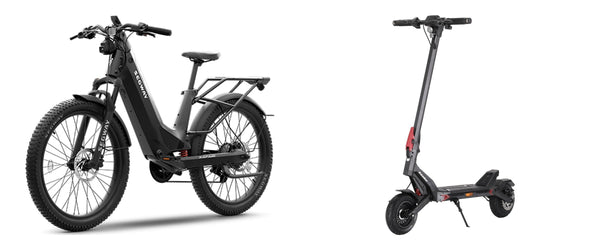
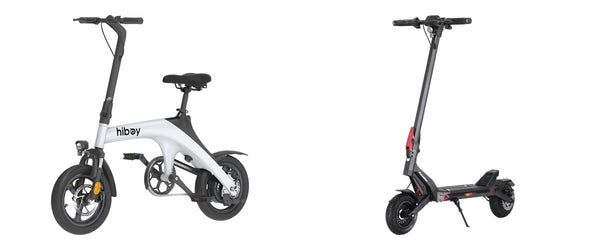
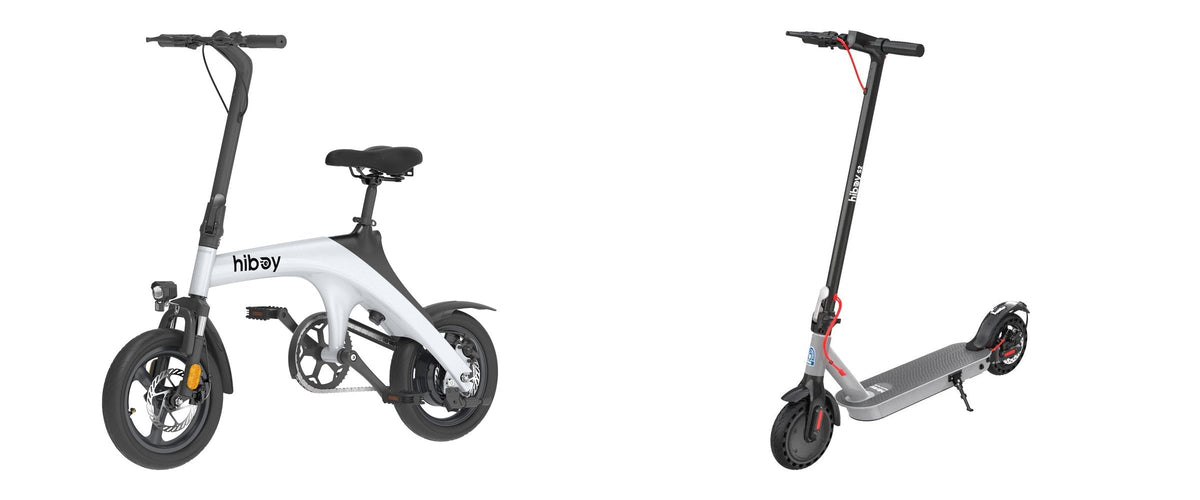
| Hiboy C1 folding e-bike | 350W rated, 648W peak | 20 mph | Has a throttle-only mode, so it rides as a Class 2: fine on roads, not on Johnson County's paved trails |
| Segway Myon e-bike | 500W rated, 1500W peak | 20 mph as Class 1 or 2, up to 28 mph as Class 3 | Under 16? Keep it set as Class 1 or 2 |
The statute doesn't say whether rated or peak power counts; the Myon's rated figure is under the limit, its peak is over it. The Hiboy EX9 is a Class 3 commuter with assist to 28 mph, but its 750W motor sits on the line rather than under it. Check the class label and motor rating on any e-bike before you buy. Browse all commuter e-bikes.
Which of our electric scooters suit Kansas riders?
Kansas sets no state speed or power limit for electric scooters, so the city rules above are what to plan around. Figures are the makers', from our product pages:
| Electric scooter | Motor (maker) | Top speed (maker) | Kansas note |
|---|---|---|---|
| Hiboy S2 | 350W, 500W peak | 19 mph | Its 13 mph Drive Mode sits under the slowest city limits above |
| Segway F3 | 1000W max | 20 mph | Riding modes are set in the app; stays inside Wichita's 20 mph limit |
| Kaabo Urban | 500W, 1092W peak | 25 mph | Faster than any Kansas city limit listed above; ride to the posted rule |
Browse all commuter electric scooters. Bought from us, each ride has a one-year Wilson's warranty against manufacturing defects, and we manage the claim with the maker. Standard shipping is free to Kansas and the rest of the lower 48 (see our shipping policy).
Where can Kansas riders get service?
We don't have a shop in Kansas. Our shops are in New York City, San Francisco and Miami, and our technicians service every brand of electric scooter and e-bike, wherever you bought it, with express service at every shop. A simple inspection is always free; a full diagnosis with disassembly or test equipment is $30, waived on repairs over $100. Starting prices, parts and labor included: brake repair from $25, flat tire repair from $40, tune-up and safety check from $50. Book a repair.
Riding in a neighboring state? See our Missouri, Oklahoma and Colorado guides, or all our state law guides.
Frequently asked questions
Do you need a license for an e-bike in Kansas?
No. A Class 1, 2 or 3 e-bike with a motor under 750 watts needs no driver's license, registration, title, license plate or insurance.
Do you need a license for an electric scooter in Kansas?
The statutes don't say directly. Electric scooters need no registration or insurance, but unlike e-bikes they aren't expressly exempted from the driver's license law. Carry your license on public roads and check your city's rules.
Can you ride an electric scooter on the road in Kansas?
Yes, on city streets and county roads where your city or county allows it, following the bicycle traffic rules. Never on an interstate, federal or state highway, though you may cross one.
Can you ride an electric scooter on the sidewalk in Kansas?
It depends on the city. Wichita bans it; Lenexa and Lawrence allow it in places, with a 15 mph limit in Lawrence.
How old do you have to be to ride an e-bike in Kansas?
16 to operate a Class 3 e-bike. Kansas sets no state minimum age for Class 1 and Class 2 e-bikes.
Do you need a helmet on an e-bike or electric scooter in Kansas?
Not under state law. Some cities require helmets for young electric scooter riders, such as Topeka (under 18) and Lawrence (under 15). We recommend one at every age.
Sources: Kansas Office of Revisor of Statutes, K.S.A. 8-1489, 8-1592b, 8-1498, 8-15,113, 8-128, 8-1437, 8-235, 8-1598, 8-1590, 8-1592 and 40-3103; Kansas Legislative Research Department, 2019 supplemental note on HB 2126 and bicycle and e-bike operation memo (January 2026); Kansas Legislature, HB 2459 (2026). Checked November 23, 2026.
This guide is general information, not legal advice. Laws and city rules change, so check the current rules before you ride.