


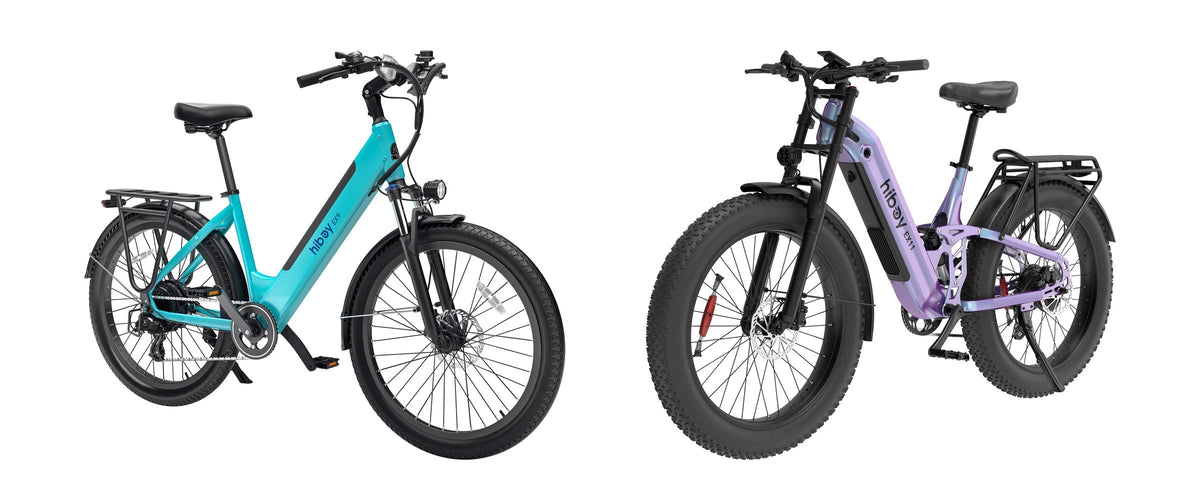


E-bikes in most US states come in three classes. A Class 1 e-bike helps only while you pedal and stops helping at 20 mph. A Class 2 e-bike also has a throttle that can move it without pedaling, up to 20 mph. A Class 3 e-bike helps only while you pedal, up to 28 mph, and usually comes with extra rules: a speedometer, riders 16 or older, a helmet, and sometimes no multi-use paths. All three have working pedals and a motor under 750 watts.
The classes come from a model law written by PeopleForBikes, the US bicycle industry's trade group, which most states have adopted in some form. States still set their own details, and a few don't use the classes at all, so the rules for where you ride are what count. Below: what each class means, how they compare, how the states we ship to most often differ, and which of our e-bikes fit which class.
Class 1 vs Class 2 vs Class 3 at a glance
| Class | How the motor helps | Stops helping at | Throttle | Extra rules in the model law |
|---|---|---|---|---|
| Class 1 | Only while you pedal | 20 mph | No | None beyond the shared rules |
| Class 2 | Can move the e-bike without pedaling | 20 mph | Yes | None beyond the shared rules |
| Class 3 | Only while you pedal | 28 mph | No (in the model law) | Speedometer, riders 16+, helmet for riders and passengers, paths can ban it |
Shared rules for every class in the model law: working pedals, a seat, a motor under 750 watts, a permanent label showing the class, top assisted speed and motor wattage, and no license, registration or insurance. Your state's own law decides; see the state table below.
What is a Class 1 e-bike?
A Class 1 e-bike has pedal assist only: the motor adds power while you pedal and stops adding it at 20 mph. There's no throttle. It's the closest thing to riding a regular bicycle, and it's the class with the fewest restrictions: under the model law it may go anywhere a bicycle can, including bike lanes and paved bicycle and multi-use paths, unless a local authority bans it from a path after a public hearing. That's why Class 1 is the usual choice for e-mountain bikes on trails that allow e-bikes, and for riders who mainly want help on hills.
What is a Class 2 e-bike?
A Class 2 e-bike has a throttle, a thumb or twist control that can move the e-bike without pedaling, and its motor stops helping at 20 mph. Most Class 2 e-bikes also have pedal assist, also limited to 20 mph. The throttle makes starting from a stop easier, which suits heavier cargo e-bikes, fat tire e-bikes and riders who can't pedal hard. Under the model law, Class 2 has the same access as Class 1. A few states treat any throttle differently: in New Jersey, a throttle puts an e-bike in a different group with more paperwork (see below).
What is a Class 3 e-bike?
A Class 3 e-bike has pedal assist that keeps helping up to 28 mph, which makes it the commuter's class: you can keep up with traffic on longer rides. Because it's faster, the model law adds four rules:
- A speedometer that shows your speed in miles per hour.
- Riders 16 or older. Younger riders may ride as a passenger on a Class 3 built for one.
- A helmet for every rider and passenger.
- Paths can ban it. The agency in charge of a bicycle or multi-use path may keep Class 3 e-bikes off it, while streets and bike lanes stay open.
The model law's Class 3 has no throttle. Some Class 3 e-bikes sold in the US also have a throttle limited to 20 mph; how a state treats that varies, so check yours.
What every class has in common
- Pedals and a motor under 750 watts. Federal law, 15 U.S.C. §2085, defines a low-speed electric bicycle the same way, with a top speed under 20 mph on motor power alone for a 170 lb rider. That federal rule covers how e-bikes are made and sold; how and where you ride is state law.
- A class label. The model law asks makers to fix a permanent label to the frame showing the class number, the top assisted speed and the motor wattage.
- No tampering. Changing an e-bike so it assists faster than its class is not allowed under the model law unless the label is changed to match.
- Treated like a bicycle. In states that follow the model law, an e-bike in one of the three classes is not a motor vehicle and needs no license, registration or insurance.
Is there a Class 4 e-bike?
No. The three-class system stops at Class 3. A two-wheeler with a motor of 750 watts or more, or one that keeps helping past 28 mph, isn't an e-bike under the model law. Depending on the state it counts as a moped, a motorcycle or an off-highway vehicle, and it may need a license, a plate and insurance. Machines sold as "Class 4" or "e-motos", and electric dirt bikes like Surron and Talaria models, fall in that group. See where to ride electric dirt bikes in New York for an example of how one state handles them.
Can an e-bike be more than one class?
Yes. Some e-bikes can be set to more than one class, usually through a display setting or an app. Segway rates the Segway Myon for Class 1 and Class 2 at 20 mph and for Class 3, with pedal assist up to 28 mph. The Hiboy EX11 and the Segway Xafari are rated as Class 2 at 20 mph and Class 3 at 28 mph. The class you ride in is the one that counts where you are, so set it to what your state, city and path allow.
How e-bike classes differ by state
These are the states we have full guides for. Each guide lists its official sources.
| State | Uses the three classes? | What's different |
|---|---|---|
| California | Yes | Class 3 riders must be 16 or older. A machine with more than 750 W, or built to go past 20 mph on motor power, can't be sold or labeled as an e-bike. |
| New York State | Yes | Class 1 and 2 are legal statewide; Class 3 is allowed only in New York City and is capped at 25 mph. Riders 16 or older, every class. |
| New York City | Yes | Every e-bike is ridden at 15 mph or less in the city. E-bikes sold in NYC must be certified to UL 2849. |
| New Jersey | No, since 2026 | A pedal-assist e-bike that stops at 20 mph is a low-speed electric bicycle; any throttle, or assist past 20 mph, makes it a motorized bicycle that must be insured. Every e-bike is registered and every rider licensed. |
| Pennsylvania | No | An e-bike is a pedalcycle with electric assist: 100 lb or less, a motor of 750 W or less, and no more than 20 mph on motor power alone. Riders 16 or older. |
| Illinois | Yes | Class 3 riders must be 16 or older, and no e-bike may be ridden on a sidewalk. A new state law starts January 1, 2027. |
| Ohio | Yes | The motor must be under 750 W. Class 3 riders must be 16 or older, and every Class 3 rider and passenger must wear a helmet, at any age. |
| Michigan | Yes | Class 3 riders must be at least 14, with a helmet under 18. Class 3 e-bikes aren't allowed on state-managed DNR trails. |
| Washington | Yes | Class 3 riders must be 16 or older. Since June 11, 2026, a machine that can go past 20 mph on its motor alone isn't an e-bike. |
| North Carolina | Yes, from December 1, 2026 | A new law adds Class 1, 2 and 3 on December 1, 2026, with a helmet for Class 3 riders and passengers under 18. Cities and counties set the rules for sidewalks and multiuse paths. |
| Georgia | Yes | Class 3 riders must be at least 15, and every Class 3 rider and passenger must wear a helmet. Class 3 e-bikes may use only paths within or next to a road. |
| Texas | Yes | Class 3 riders must be at least 15. No statewide helmet law. |
| Florida | Yes | No statewide minimum age. Riders under 16 must wear a helmet. |
Cities, counties, parks and trail agencies can add their own rules in every state. General information, not legal advice.
Which e-bike class should you buy?
- Class 1 if you want the most places to ride, including trails that allow e-bikes, and you're happy to pedal all the time.
- Class 2 if you want a throttle for starts, heavy loads or days you'd rather not pedal, and 20 mph is enough.
- Class 3 if you commute longer distances on streets and bike lanes, you're 16 or older and you'll wear a helmet. Check that your state and your route allow it.
- A multi-class e-bike if you ride in more than one place with different rules.
For picks by how you ride, see the best electric bikes of 2026; for New York City, the best e-bikes for NYC.
Our e-bikes by class
These are the classes each maker publishes for the e-bikes we sell. Where a maker doesn't publish a class, we don't guess one.
| E-bike | Maker's class | Assist up to |
|---|---|---|
| Segway Myon | Class 1, 2 or 3 | 20 mph (Class 1 and 2), 28 mph (Class 3) |
| Segway Xafari | Class 2 or 3 | 20 mph (Class 2), 28 mph (Class 3) |
| Hiboy EX11 | Class 2 or 3 | 20 mph (Class 2), 28 mph pedal assist (Class 3) |
| Hiboy EX9 | Class 3 | 20 mph by default, pedal assist up to 28 mph |
| Hiboy P6 | Class 3 | 28 mph |
Classes and speeds are the makers' own, from our product pages. Several of these have a 750 W rated motor: California's limit is 750 W, while New York and the model law say under 750 W, so check your state's wattage limit too. E-bikes with a motor of 750 watts or more, or able to provide motor assistance at 25 mph or more, aren't sold or shipped to New York City addresses. Browse every electric bike or commuter e-bike.
E-bike service at Wilson's
Our technicians service e-bikes of every class and every brand, wherever you bought them, with express service at every shop. A simple inspection is free. Common jobs start at brake repair from $25, a speed sensor and magnet from $35, pedal assist and torque sensor repair from $35, throttle repair from $50 and a tune-up and safety check from $50. Prices include parts and labor and depend on the model. See e-bike repair or walk in at any Wilson's shop.
Frequently asked questions
What is a Class 1 e-bike?
An e-bike whose motor helps only while you pedal and stops helping at 20 mph, with no throttle. Under the model law it can go anywhere a bicycle can, unless a path's managers ban it.
What is a Class 2 e-bike?
An e-bike with a throttle that can move it without pedaling, with the motor stopping at 20 mph. Most also have pedal assist to 20 mph.
What is a Class 3 e-bike?
An e-bike whose motor helps only while you pedal, up to 28 mph. The model law adds a speedometer, a minimum rider age of 16, helmets for riders and passengers, and lets path managers ban Class 3 from bicycle and multi-use paths.
What's the difference between Class 1 and Class 2 e-bikes?
The throttle. Both stop helping at 20 mph, but only Class 2 can move without pedaling. Most states give them the same access; a few, like New Jersey, treat any throttle differently.
Do you need a license for a Class 3 e-bike?
Not in states that follow the model law: an e-bike in any of the three classes needs no license, registration or insurance. Some states differ; New Jersey now requires registration and a license for every e-bike.
Can you ride a Class 3 e-bike on a bike path?
Often, but not always. Class 3 e-bikes can use streets and bike lanes, and the agency in charge of a bicycle or multi-use path can keep them off it. Look for posted signs.
Is there a Class 4 e-bike?
No. Anything with a motor of 750 watts or more, or assist past 28 mph, isn't an e-bike under the three-class system; states treat it as a moped, a motorcycle or an off-highway vehicle.
Can I change my e-bike's class?
Only if the maker built it to switch, like the Segway Myon, Segway Xafari and Hiboy EX11. Modifying an e-bike to assist faster than its class isn't allowed under the model law unless the class label is changed to match.
Sources: PeopleForBikes, Model Electric Bicycle Law with Classes (January 2020 text), read November 2026; 15 U.S.C. §2085 (definition of a low-speed electric bicycle); state rules as set out, with their official sources, in our California, New York State, New York City, New Jersey, Pennsylvania, Illinois, Ohio, Michigan, Washington, North Carolina, Georgia, Texas and Florida guides; makers' classes from our product pages, read November 2026. Repair prices: Wilson's price list. General information, not legal advice.


