




In Georgia, an e-bike has working pedals, a saddle and a motor of 750 watts or less, in Class I, II or III. You need no license or permit to ride one. Class III e-bikes, with pedal assist up to 28 mph, need a speedometer, riders 15 or older and a helmet for every rider and passenger. Georgia has no state law for stand-up electric scooters, so cities such as Atlanta set the rules.
We ship electric scooters and e-bikes to riders across the country, Georgia included. Here are the state rules, where each one is written in the Official Code of Georgia (O.C.G.A.), and what cities add. The official sources are listed at the end.
Georgia e-bike and electric scooter rules at a glance
| Rule | E-bike | Electric scooter |
|---|---|---|
| Where the law is | O.C.G.A. 40-1-1 (definition) and 40-6-300 to 40-6-303 | No state law |
| What counts | Two or three wheels, a saddle, fully working pedals and a motor of 750 watts or less, in Class I, II or III | Not defined in state law |
| License | None (O.C.G.A. 40-6-351) | No state rule |
| Minimum age | 15 for Class III; no state minimum for Class I and II | No state rule |
| Helmet | Every Class III rider and passenger; no state rule for Class I and II | No state rule |
| Paths | Class I and II allowed unless banned; Class III only on paths within or next to a road, with limited exceptions | Set by cities |
| Sidewalks | Georgia bans vehicles on sidewalks | Atlanta bans sidewalk riding |
What are the e-bike classes in Georgia?
A Georgia e-bike has two or three wheels, a saddle, fully working pedals and an electric motor of 750 watts or less (O.C.G.A. 40-1-1). It comes in one of three classes (O.C.G.A. 40-6-300):
- Class I: the motor helps only while you pedal and stops helping at 20 mph.
- Class II: the motor can move the e-bike on its own (a throttle) and stops helping at 20 mph.
- Class III: the motor helps only while you pedal and stops helping at 28 mph. A Class III e-bike must have a speedometer.
E-bikes made on or after January 1, 2020 must carry a permanent label showing the class, the motor wattage and the top assisted speed, and anyone who changes an e-bike so its class changes must relabel it to match (O.C.G.A. 40-6-302). See e-bike classes explained for how the classes compare across the states.
Do you need a license for an e-bike in Georgia?
No. Georgia law says no license or permit is needed to ride an e-bike (O.C.G.A. 40-6-351), and an e-bike isn't a motor vehicle under the state's definitions (O.C.G.A. 40-1-1). E-bike riders have the same rights and duties as bicycle riders (O.C.G.A. 40-6-301).
How old do you have to be to ride an e-bike in Georgia?
15 for a Class III e-bike. A rider under 15 may ride as a passenger on a Class III built to carry one (O.C.G.A. 40-6-303). Georgia sets no state minimum age for Class I and Class II e-bikes.
Do you need a helmet on an e-bike in Georgia?
On a Class III e-bike, yes, for every rider and passenger, at any age, and rental companies must provide a helmet with a Class III rental (O.C.G.A. 40-6-303). Georgia has no state e-bike helmet rule for Class I and Class II. We recommend a helmet on every ride; see helmets and safety gear.
Where can you ride an e-bike in Georgia?
On roads, under the same rules as bicycles. On paths, O.C.G.A. 40-6-303 sets the defaults:
- Class I and Class II may use any bicycle path or shared-use path, unless the local government or state agency in charge bans them from a path it controls.
- Class III may use a bicycle path or shared-use path only if the path is within or next to a road, with limited exceptions.
Georgia bans driving any vehicle on a sidewalk, with one exception local governments may make for bicycle riders 12 and younger (O.C.G.A. 40-6-144). Some state trails are designated and signed as bicycle and e-bike routes (O.C.G.A. 12-3-114).
At night, a bicycle needs a front light visible from 300 feet and a red rear light visible from 300 feet (O.C.G.A. 40-6-296), and e-bikes must carry the same equipment as bicycles (O.C.G.A. 40-6-302).
Are electric scooters legal in Georgia?
Georgia has no state law for stand-up electric scooters: the Official Code doesn't define one. A 2020 bill (Senate Bill 159) would have added a definition, but it never became law. So there is no statewide electric scooter speed limit, age limit or helmet rule, and cities set the rules.
In Atlanta, the city permits shared electric scooters under a 2020 ordinance. Its guidance says riding on the sidewalk is never allowed: ride in bike lanes, on multi-use trails or in the street. Shared electric scooters and e-bikes can't be rented between 9 PM and 4 AM; that night rule doesn't apply to ones you own. Check your own city's rules before you ride.
A self-balancing device, such as a two-wheeled Segway with the rider standing between the wheels, is its own category: under 20 mph with a motor of 750 watts or less. It may use roads with a speed limit of 35 mph or less, or roads with a striped bike lane, and is limited to 7 mph on sidewalks and 15 mph elsewhere (O.C.G.A. 40-1-1, 40-6-320 and 40-6-322).
What about mopeds and electric dirt bikes?
A moped in Georgia has two or three wheels and no more than two brake horsepower (O.C.G.A. 40-1-1). Moped riders must be 15 or older and need a license or permit (O.C.G.A. 40-6-351).
Electric dirt bikes such as Surron and Talaria models have no working pedals, so they aren't e-bikes under Georgia law, and the e-bike rules don't cover them on public roads. See our electric dirt bikes and Surron vs Talaria.
Can you ride an e-bike drunk in Georgia?
No. Georgia's DUI law covers any moving vehicle (O.C.G.A. 40-6-391), and the state's definition of a vehicle covers any device for carrying people on a highway (O.C.G.A. 40-1-1).
Which of our rides fit Georgia's rules?
For an e-bike, look for a Class I, II or III label and a motor of 750 watts or less. These fit, on the maker's own figures:
| E-bike | Motor (rated) | Assist and throttle (maker) | Georgia class |
|---|---|---|---|
| Hiboy C1 | 350W | Up to 20 mph on throttle and pedal assist | Class II |
| Segway Myon | 500W | Class 1 and 2 at 20 mph; Class 3 pedal assist up to 28 mph | Class I, II or III, by setting |
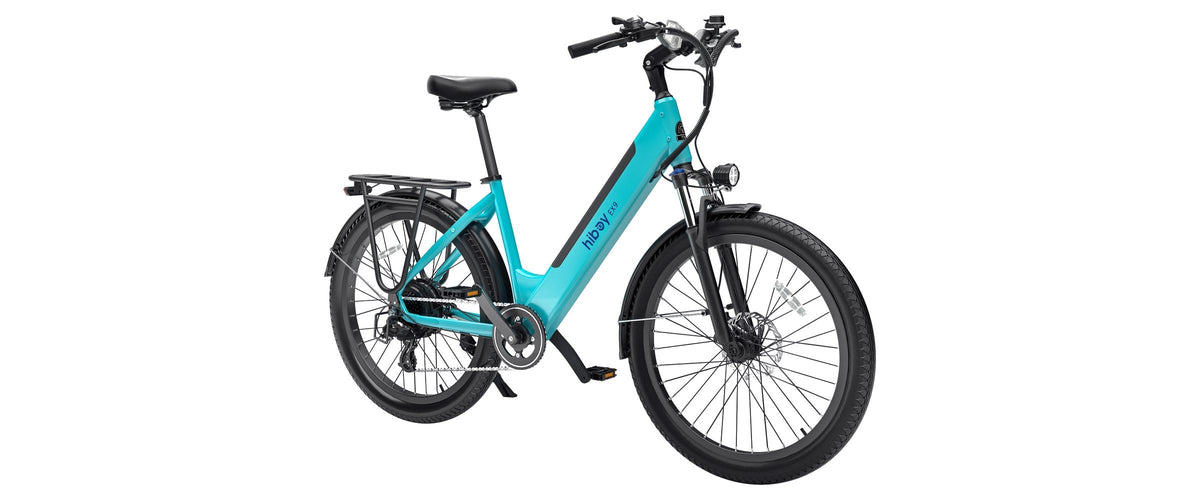
| Hiboy EX9 | 750W | 20 mph by default; pedal assist up to 28 mph | Class III |
On a Class III setting, riders must be 15 or older, and every rider and passenger needs a helmet. For electric scooters, check your city's rules first. These are the commuters we recommend most, on the maker's figures:
| Electric scooter | Top speed (maker) | Range (maker) | Weight (maker) |
|---|---|---|---|
| Hiboy S2 Pro | 19 mph | Up to 25 miles | 37.4 lb |
| Segway F3 | About 20 mph | Up to 44 miles (Eco) | 42 lb |
Bought from us, each one has a one-year Wilson's warranty against manufacturing defects, and we manage the claim with the maker. Standard shipping is free to Georgia and the rest of the lower 48 (see our shipping policy). Browse commuter e-bikes and commuter electric scooters.
Where can Georgia riders get service?
Our shops are in New York City, San Francisco and Miami, and our technicians service every brand, wherever you bought it, with express service at every shop. If you're visiting, walk in with no appointment. A simple inspection is always free; a full diagnosis with disassembly or test equipment is $30, waived on repairs over $100. Brake repair starts from $25 and a flat tire repair from $40, parts and labor included. Book a repair at our New York and San Francisco shops.
Compare other states in our Arizona, Florida, North Carolina and Texas guides, or see all our state law guides.
Shop e-bikes at Wilson's, with free shipping to the lower 48.
Frequently asked questions
Do you need a license for an e-bike in Georgia?
No. Georgia law says no license or permit is needed to ride an e-bike in Class I, II or III.
How old do you have to be to ride an e-bike in Georgia?
15 for a Class III e-bike. There's no state minimum age for Class I and Class II.
Do you need a helmet on an e-bike in Georgia?
On a Class III e-bike, yes, for every rider and passenger at any age. Georgia has no state helmet rule for Class I and II e-bikes.
Can you ride an e-bike on the sidewalk in Georgia?
Georgia bans driving any vehicle on a sidewalk; local governments may allow bicycles on sidewalks only for riders 12 and younger. Ride in the street, in bike lanes or on paths where e-bikes are allowed.
Are electric scooters legal in Georgia?
Georgia has no state law for stand-up electric scooters, so cities set the rules. In Atlanta, riding on the sidewalk is never allowed, and shared electric scooters can't be rented from 9 PM to 4 AM.
Can a Class III e-bike go on a bike path in Georgia?
Only on a bicycle or shared-use path within or next to a road, with limited exceptions. Class I and II may use any bicycle or shared-use path unless the agency in charge bans them.
Sources: Official Code of Georgia Annotated 40-1-1, 40-6-144, 40-6-296, 40-6-300, 40-6-301, 40-6-302, 40-6-303, 40-6-320, 40-6-322, 40-6-351, 40-6-391 and 12-3-114, read in the official code published for the Georgia Code Revision Commission; Georgia Senate Bill 159 (2019–2020 session); City of Atlanta, Shareable Dockless Mobility Devices. Checked November 2026.
This guide is general information, not legal advice. Laws change and cities add their own rules, so check your local rules before you ride.


