




North Carolina's e-bike law changes on December 1, 2026. From that date, an e-bike has working pedals and a motor of 750 watts or less, in Class 1, 2 or 3, and may be ridden on roads, bike lanes and multiuse paths, with Class 3 assist up to 28 mph. Riders and passengers under 18 on a Class 3 e-bike must wear a helmet. You still need no license or registration. North Carolina law has no definition of a stand-up electric scooter, so the rules for those come mostly from cities.
We ship electric scooters and e-bikes to riders across the country, North Carolina included. Here is what the law says today, what changes on December 1, and where each rule is written. The official sources are listed at the end.
What changes on December 1, 2026?
Session Law 2026-46 (House Bill 1094, a transportation bill signed on July 7, 2026) rewrites the e-bike rules in its Section 19. It takes effect on December 1, 2026:
- Three classes. The old limit, a top speed of 20 mph on the motor alone, is replaced with Class 1, 2 and 3 (G.S. 20-4.01(7a)). The 750-watt motor limit stays.
- Where you can ride. A new section, G.S. 20-171.3, says e-bikes may be ridden on all roadways, bicycle lanes and multiuse paths, subject to local rules and to the rules in state parks and historic sites.
- A Class 3 helmet rule. Anyone under 18 riding, or riding as a passenger on, a Class 3 e-bike must wear a helmet that meets federal safety standards (G.S. 20-171.3).
- Local control. Cities and counties may regulate e-bikes on multiuse paths and sidewalks, including limiting which classes may use them and setting speed limits, and may require helmets for riders and passengers under 18 on Class 1 and Class 2 e-bikes (G.S. 160A-300.2 and 153A-245.1).
- Safety education. NCDOT must develop e-bike safety materials.
The new law doesn't add a minimum age, a labeling rule or a rule against modifying an e-bike.
North Carolina e-bike and electric scooter rules at a glance
| Rule | E-bike, until Nov 30, 2026 | E-bike, from Dec 1, 2026 | Electric scooter |
|---|---|---|---|
| What counts | Working pedals, a motor of 750 watts or less, and no more than 20 mph on the motor alone | Working pedals, a motor of 750 watts or less, in Class 1, 2 or 3 | No definition in state law |
| License, registration | None | None | No state rule; shared fleets set their own |
| Minimum age | No state minimum | No state minimum | No state minimum; Charlotte and Raleigh shared fleets require 18 |
| Helmet | No state e-bike rule | Under 18 on a Class 3; cities may add under 18 on Class 1 and 2 | No state rule |
| Where to ride | Under the rules for vehicles and bicycles | Roads, bike lanes and multiuse paths, subject to local rules | Set by cities |
What are the e-bike classes in North Carolina?
From December 1, 2026, an e-bike in North Carolina has two or three wheels, a seat or saddle, fully working pedals and an electric motor of 750 watts or less (G.S. 20-4.01(7a)), in one of three classes:
- Class 1: the motor helps only while you pedal and stops helping at 20 mph.
- Class 2: the motor can move the e-bike without pedaling (a throttle) and stops helping at 20 mph.
- Class 3: the motor helps only while you pedal and stops helping at 28 mph.
Until then, the definition has no classes: an e-bike's motor must not push it past 20 mph on a level surface on its own. A pedal-assist e-bike that helps up to 28 mph only fits the e-bike definition from December 1. See e-bike classes explained for how the classes work across the states.
Do you need a license for an e-bike in North Carolina?
No. North Carolina law excludes e-bikes from the definition of a motor vehicle (G.S. 20-4.01(23)), and a driver's license is required for motor vehicles (G.S. 20-7), so an e-bike needs no license. No state law requires e-bike registration or insurance. An e-bike is still a vehicle under North Carolina law (G.S. 20-4.01(49)), so its rider follows the rules of the road.
Do you need a helmet on an e-bike in North Carolina?
From December 1, 2026, yes on a Class 3 e-bike for riders and passengers under 18, with a helmet that meets federal safety standards (G.S. 20-171.3). For Class 1 and Class 2 e-bikes there is no statewide helmet rule, but cities and counties may now require one for riders and passengers under 18 (G.S. 160A-300.2 and 153A-245.1). We recommend a helmet on every ride; see helmets and safety gear.
Where can you ride an e-bike in North Carolina?
From December 1, 2026, on all roadways, bicycle lanes and multiuse paths (G.S. 20-171.3). That permission is subject to local rules and, in state parks and historic sites, to the Department of Natural and Cultural Resources.
The new section doesn't list sidewalks. Instead, it lets cities and counties regulate e-bikes on sidewalks and multiuse paths within their limits, including which classes may use them and how fast. Rules can differ from one town or greenway to the next, so check the signs and your city's rules before riding on a sidewalk or greenway.
At night, North Carolina requires a bicycle on a public street, public vehicular area or public greenway to have a front lamp visible from at least 300 feet, a rear reflector, and a red rear lamp or reflective clothing visible from 300 feet (G.S. 20-129(e)). Both e-bikes below come with a front light and a rear light from the maker.
Are electric scooters legal in North Carolina?
North Carolina law doesn't define a stand-up electric scooter, and there is no statewide electric scooter rulebook. In practice, the rules come from cities, many of which run shared electric scooter programs:
- Charlotte: the city's shared program requires riders to be 18 with a valid driver's license, caps electric scooters at 15 mph, and allows sidewalk riding everywhere except Uptown.
- Raleigh: the city's shared program requires riders to be 18, bans sidewalk riding and asks riders to use bike lanes where they can.
Those are the rules for each city's shared fleet; check with your city on rules for an electric scooter you own.
A self-balancing device, such as a two-wheeled Segway with the rider standing between the wheels, is a separate category with a top speed of 15 mph or less. It needs no registration and may be ridden on roads posted at 25 mph or less, on sidewalks and on bicycle paths, with a pedestrian's rights and duties. Cities may regulate when and where, but may not ban them (G.S. 20-4.01(7b) and 20-175.6).
What about mopeds, faster rides and electric dirt bikes?
A moped in North Carolina has two or three wheels, no external shifting, a motor of 50 cc or less, and a top speed of no more than 30 mph; electric models count (G.S. 20-4.01(27)). Moped riders must be 16 or older (G.S. 20-10.1), need no driver's license or motorcycle endorsement (G.S. 20-7), must register the moped (G.S. 20-53.4), and the rider and any passenger must wear a motorcycle helmet (G.S. 20-140.4).
Faster machines can fall under the motorcycle rules, which cover faster two- and three-wheeled machines with a seat and require a driver's license with a motorcycle endorsement or learner's permit and a helmet (G.S. 20-4.01(27), 20-7 and 20-140.4). Electric dirt bikes such as Surron and Talaria models have no working pedals, so they aren't e-bikes; Raleigh police describe e-motos of this kind as needing registration, insurance and an endorsed license, and keep them off the city's greenways. See our electric dirt bikes and Surron vs Talaria.
Can you ride an e-bike drunk in North Carolina?
No. North Carolina's impaired-driving law covers driving any vehicle on a highway, street or public vehicular area (G.S. 20-138.1), and e-bikes are vehicles under state law (G.S. 20-4.01(49)).
Which of our rides fit North Carolina's rules?
For an e-bike, look for working pedals and a motor of 750 watts or less. These fit, on the maker's own figures:
| E-bike | Motor (rated) | Assist and throttle (maker) | Class from Dec 1 |
|---|---|---|---|
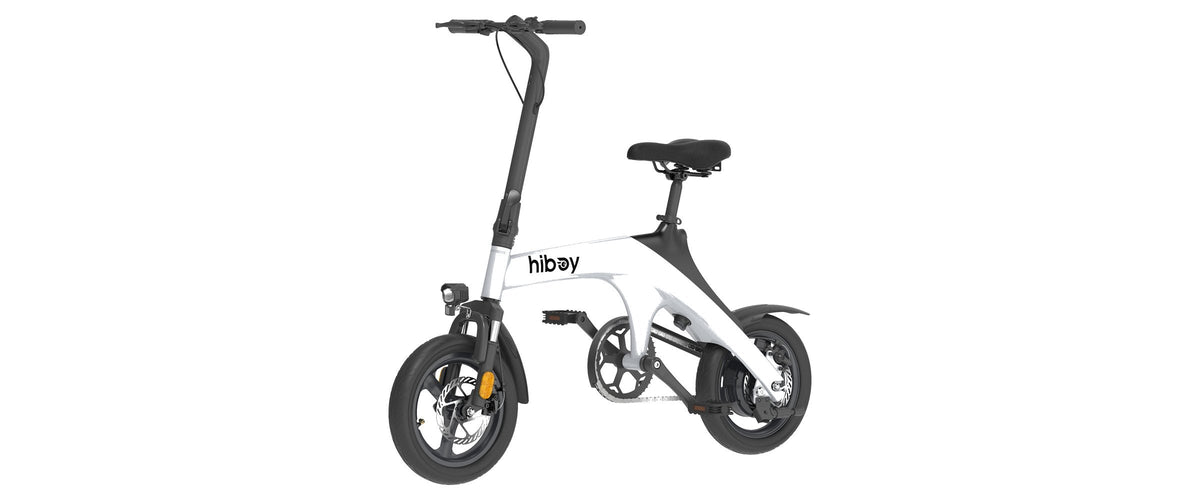
| Hiboy C1 | 350W | Up to 20 mph on throttle and pedal assist | Class 2 |
| Segway Myon | 500W | Class 1 and 2 at 20 mph; Class 3 pedal assist up to 28 mph | Class 1, 2 or 3, by setting |
Set to Class 3, a Segway Myon fits the e-bike definition from December 1, and riders and passengers under 18 need a helmet. For electric scooters, check your city's rules first. These are the commuters we recommend most, on the maker's figures:
| Electric scooter | Top speed (maker) | Range (maker) | Weight (maker) |
|---|---|---|---|
| Hiboy S2 Pro | 19 mph | Up to 25 miles | 37.4 lb |
| Segway F3 | About 20 mph | Up to 44 miles (Eco) | 42 lb |
Bought from us, each one has a one-year Wilson's warranty against manufacturing defects, and we manage the claim with the maker. Standard shipping is free to North Carolina and the rest of the lower 48 (see our shipping policy). Browse commuter e-bikes and commuter electric scooters.
Where can North Carolina riders get service?
Our shops are in New York City, San Francisco and Miami, and our technicians service every brand, wherever you bought it, with express service at every shop. If you're visiting, walk in with no appointment. A simple inspection is always free; a full diagnosis with disassembly or test equipment is $30, waived on repairs over $100. Brake repair starts from $25 and a flat tire repair from $40, parts and labor included. Book a repair at our New York and San Francisco shops.
Compare other states in our Ohio, Washington and Florida guides, or see all our state law guides.
Shop e-bikes at Wilson's, with free shipping to the lower 48.
Frequently asked questions
When does the new North Carolina e-bike law take effect?
December 1, 2026. Session Law 2026-46 adds Class 1, 2 and 3, sets where e-bikes may be ridden, and adds a Class 3 helmet rule for riders under 18.
Do you need a license for an e-bike in North Carolina?
No. E-bikes aren't motor vehicles under North Carolina law, so no driver's license, registration or insurance is required.
Do you need a helmet on an e-bike in North Carolina?
From December 1, 2026, riders and passengers under 18 on a Class 3 e-bike must wear one. Cities and counties may also require helmets for riders under 18 on Class 1 and 2 e-bikes.
Can you ride an e-bike on the sidewalk in North Carolina?
The new law lets cities and counties set the rules for e-bikes on sidewalks and multiuse paths, so it depends on where you are. Check your city's rules.
Are electric scooters legal in North Carolina?
State law doesn't define a stand-up electric scooter. Cities set the rules: Charlotte's and Raleigh's shared programs require riders to be 18, and Raleigh bans sidewalk riding.
Is a 28 mph e-bike legal in North Carolina?
From December 1, 2026, a pedal-assist e-bike that stops helping at 28 mph is a Class 3 e-bike under state law. Before then, the e-bike definition covers only e-bikes that go no faster than 20 mph on the motor alone.
Sources: House Bill 1094, Session Law 2026-46 (Section 19); North Carolina General Statutes 20-4.01, 20-7, 20-10.1, 20-53.4, 20-129, 20-138.1, 20-140.4, 20-171.3, 20-175.6, 160A-300.2 and 153A-245.1; City of Charlotte shared mobility program; City of Raleigh dockless electric scooter program. Checked November 2026.
This guide is general information, not legal advice. Laws change and cities add their own rules, so check your local rules before you ride.


