

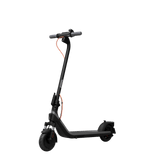
Watt-hours (Wh) are the size of an electric scooter battery: the total energy it holds, worked out as volts multiplied by amp-hours. Segway's GT3 Pro, for example, carries 72 V x 30 Ah = 2160 Wh. Light commuters we sell run from about 220 to 600 Wh; long-range and performance models run from about 1,200 to 2,900 Wh, and that number, more than volts or amp-hours alone, tells you how far an electric scooter can go and how heavy it will be.
Spec sheets list the battery three ways, often in a different order from one maker to the next, and a bigger number in one column doesn't always mean a bigger battery. This guide explains the three units in plain words, compares the batteries in the electric scooters we sell, and covers what changes when a battery gets older.
Volts, amp-hours and watt-hours in plain words
- Volts (V) are the pressure the battery pushes with. Higher voltage lets the motors draw more power, which is why fast electric scooters run 60V or 72V systems. It says nothing about size on its own.
- Amp-hours (Ah) are how much current the battery can deliver over an hour. On their own they are only half the story: 20 Ah at 48V and 20 Ah at 72V are very different batteries.
- Watt-hours (Wh) combine the two. Volts x amp-hours = watt-hours, the actual energy stored. This is the number to compare across brands.
When a maker leaves the watt-hours off, the multiplication fills the gap. Hiboy lists the Hiboy S2 Pro battery as 36V 11.6Ah, which works out to about 418 watt-hours.
Why a "48V" battery can say 46.8 V
The voltage in the name is the nominal voltage, an average over the charge. A full battery sits higher and an empty one lower. Segway prints both: the Segway ZT3 Pro battery is 46.8 V nominal and 54.6 V when fully charged.
The GT3 Pro is 72 V nominal and 84 V at full charge. That top figure is also what its charger is built to deliver, which is why a charger has to match its battery's voltage exactly.
Battery capacity of the electric scooters we sell
The makers' own figures, smallest battery first. Range is each maker's rating, which is measured in their own way (more on that below):
| Electric scooter | Volts | Amp-hours | Watt-hours | Maker's range rating | Weight |
|---|---|---|---|---|---|
| Segway E2 Plus II | 21.6 V | 10.2 Ah | 220 Wh | 15.5 mi in Eco | 36.2 lbs |
| E-TWOW Booster ES | 36V | 7.8Ah | 281 Wh | 19 mi | 25.6 lbs |
| Wilson's Mosquito | 48V | 9.6Ah | 461Wh | 22 mi at a constant 15 mph | 29 lb |
| E-TWOW GT Sport | 48V | 10.5Ah | 504 Wh | 25 miles | 29.3 lbs |
| Segway ZT3 Pro | 46.8 V | 12.75 Ah | 597 Wh | 43.5 mi in Eco | 65.5 lbs |
| Ausom DT2 Pro | 52V | 23.4Ah | 1216.8Wh | 71 miles | 74 lbs |
| Nami Klima | 60V | 25Ah | 1,500 Wh | 50 miles | 79 lb |
| Teverun Blade Mini Ultra | 60V | 27Ah | 1620Wh | 62 miles | 65 lbs |
| Nami Burn-E 4 | 72V | 30Ah | 2,155Wh | 62 miles | Not listed |
| Segway GT3 Pro | 72 V | 30 Ah | 2160 Wh | 86 mi in Eco | 117.1 lbs |
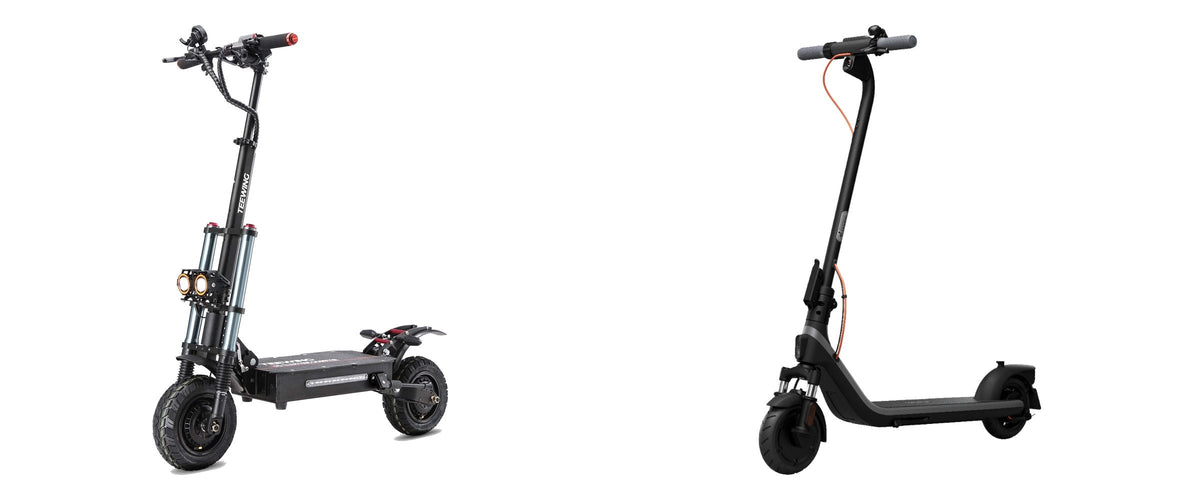
| Teewing X5 | 60V | 38Ah | 2280Wh | 75 miles | 100 lbs |
| Nami Burn-E 4 Max | 72V | 40Ah | 2,880Wh | 62 miles | 103 lb |
Battery, range and weight figures are each maker's published specifications, as listed on our product pages, read November 2026. Range ratings depend on rider weight, speed, mode, terrain and temperature.
Is a higher voltage a bigger battery?
Not by itself. A 60V battery with few amp-hours can hold less energy than a 52V battery with many.
The Kaabo Mantis King Pro runs a 60V 18Ah pack, about 1,080 watt-hours by the multiplication, and Kaabo makes it removable so it can come upstairs on its own. The Ausom DT2 Pro in the table runs a lower voltage, but its bigger pack holds more energy.
Voltage mostly decides how hard the motors can pull, which is the subject of our 48V vs 60V vs 72V guide; watt-hours decide how long they can keep pulling.
How many miles do you get per watt-hour?
E-TWOW is one of the few makers that publishes consumption, the energy used per mile, and its figures show how wide the spread is:
- The E-TWOW GT SL, a light single-motor commuter, uses about 9.9 Wh per mile.
- The E-TWOW Booster ES uses 9.90 to 12.39 Wh per mile, depending on how it is ridden.
- The dual-motor E-TWOW TankTorq TK2 uses 20.9 Wh per mile with a 176 lb rider, about twice as much, which is why its 600 Wh battery is rated for up to 28 miles.
Heavier riders, hills, cold, higher speeds and a second motor all raise the watt-hours per mile. So watt-hours predict range well within one kind of electric scooter, and less well across very different ones.
Why two batteries the same size carry different range ratings
Look at the Nami Burn-E 4 and the Segway GT3 Pro in the table: 2,155 Wh and 2160 Wh, nearly identical, rated for 62 miles and 86 miles. Range ratings are measured by each maker under its own conditions. Segway's 86 miles is in Eco mode at 15.5 mph; in its Race mode, Segway rates the same battery for 34 miles.
The Kaabo King GTR Max makes the same point at the top end: its 72V 40Ah Samsung pack is the same size as the Burn-E 4 Max's, but Kaabo quotes a 124 mi maximum range against Nami's 62.
So compare watt-hours first, then read the range rating with its conditions. Our best long-range electric scooters guide compares the long-range models in more detail.
What a bigger battery costs you in weight
Capacity is cells, and cells are heavy. In the table, the 220 Wh Segway E2 Plus II weighs 36.2 lbs and the 2,880 Wh Burn-E 4 Max weighs 103 lb. The motors, brakes and suspension grow with the battery too, so the jump from a commuter to a long-range machine is usually from something you carry to something you roll. Watt-hours per pound vary with design: the Teverun Blade Mini Ultra puts 1620 Wh in a 65 lb electric scooter, while the Nami Klima carries 1,500 Wh at 79 lb with heavier hydraulic suspension. If stairs or a car trunk are part of your day, weight is the trade-off to weigh against every extra watt-hour; our long-range electric scooters list both on every product page.
Why capacity drops with age, and what we test
A lithium-ion battery loses capacity as it ages, so a 600 Wh battery holds less than 600 Wh a few years in. Segway's own warranty for the ZT3 Pro shows where a maker draws the line: within the warranty period, a lithium battery that measures under 70% of its capacity at 25°C counts as a fault. Our guide to how long electric scooter batteries last covers what wears a battery out.
When an electric scooter comes in with range loss, our technicians measure how much energy the battery still holds instead of guessing from the gauge:
| What we test or fix | Starting price |
|---|---|
| Battery load, capacity and discharge test with a health report | $50, waived if your repair quote is over $100 |
| Range loss or won't hold a charge | $50 |
| Charger replacement (a charger that stops short can look like lost capacity) | $35 |
| BMS diagnosis and replacement | $200 |
| Swollen or wet battery safety check | $70 |
| Battery replacement | Quoted after the test |
Starting prices, parts and labor included; the final price depends on the model and the part. A simple inspection is always free. More in electric scooter battery replacement.
A battery bought with an electric scooter from us is covered for one year against manufacturing defects on every brand we carry, with Wilson's managing the claim; Wilson's-designed rides such as the Mosquito carry three years. Wear and water damage are excluded. See our warranty policy.
Never charge a battery that is swollen, wet, damaged or has been in a crash. Bring it straight in; the safety check starts at $70.
Where to get a battery tested
We test batteries on any brand of electric scooter at all six Wilson's shops, wherever you bought it:
- Flushing: 35-23 Farrington St, Flushing, NY 11354
- Elmhurst: 82-15 Queens Blvd, Elmhurst, NY 11373
- Brooklyn: 268 Richardson St, Brooklyn, NY 11222
- Long Island City: 41-13 31st Ave, Long Island City, NY 11103
- San Francisco: 360 11th St, San Francisco, CA 94103
- Miami: 2235 NW 20th St, Miami, FL 33142 (walk-ins)
Walk in, or book a repair at our New York and San Francisco shops. Call (516) 300-0944 for any shop.
Frequently asked questions
What is a good battery size for an electric scooter?
For short city trips, the 220 to 600 Wh batteries on light commuters are plenty and keep the weight under about 40 lbs on many models. For long daily rides, hills or heavier riders, 1,200 Wh and up. Watt-hours matter more than volts or amp-hours alone.
Is Ah or Wh more important?
Watt-hours. Amp-hours only compare batteries of the same voltage; watt-hours (volts x amp-hours) compare any two batteries.
How many miles is 1,000 Wh on an electric scooter?
It depends on the electric scooter and the rider. At E-TWOW's published 9.9 to 20.9 Wh per mile, 1,000 Wh would cover roughly 48 to 100 miles; heavier, faster dual-motor machines use more per mile, so their range per watt-hour is lower.
What does 48V 13Ah mean?
A 48-volt battery that can deliver 13 amps for an hour: 48 x 13 = 624 watt-hours of stored energy.
Can I put a bigger battery on my electric scooter?
Only a battery the maker specifies for that model, with the same voltage, connector and fit; the controller, charger and battery management system are built around it. We fit maker batteries, and battery replacement is quoted after the test.
Why does my battery show full but run out early?
Usually lost capacity or a battery management system cutting out early, sometimes a charger stopping short. Our technicians load-test the battery and test the charger to find which; testing starts at $50.
Sources: makers' published specifications as listed on our product pages (Segway, E-TWOW, Ausom, Kaabo, Nami, Teverun, Teewing, Hiboy and Wilson's), and Segway's ZT3 Pro limited warranty (store.segway.com), read November 2026. Watt-hour figures marked "by the multiplication" are our own arithmetic. Repair prices: Wilson's price list. Warranty: Wilson's warranty policy.