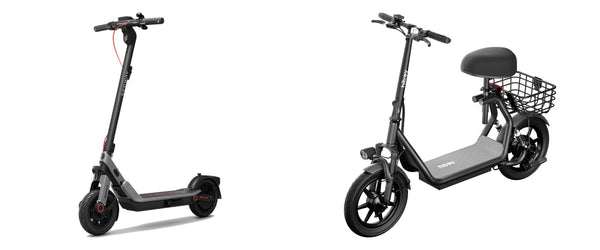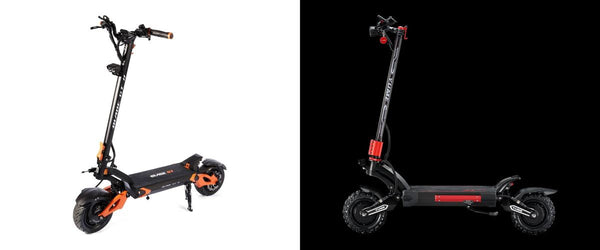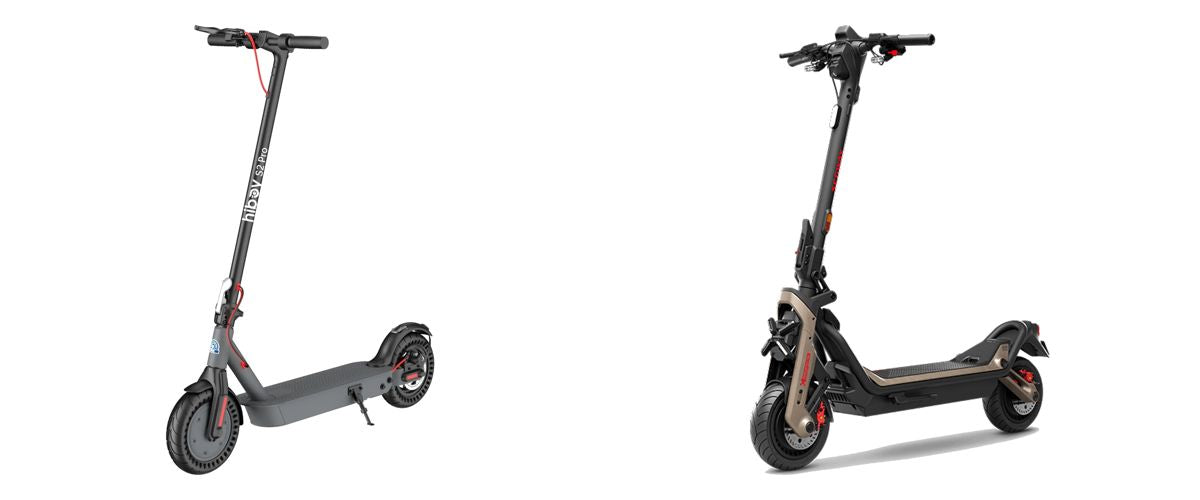
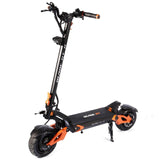
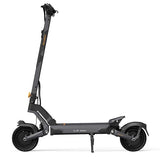
Usually, yes: across the electric scooters we sell, the higher the battery voltage, the higher the top speed. Our 36V commuters top out at 13 to 20 mph, 48V models run 19 to 38 mph, 60V models 25 to 56 mph, and 72V flagships 50 to 74 mph, all on the makers' figures. But voltage sets the ceiling, not the speed: the motors, controller and the maker's speed modes decide where a model lands, and range depends on the battery's total energy, not its voltage. Here's what each voltage gets you, and what it costs.
Top speed and price by voltage
These are the spreads across the electric scooters we sell, from each maker's own top-speed figure, with prices as bands.
| Battery voltage | Top speeds (makers' figures) | Price band* | What it's built for |
|---|---|---|---|
| 36V | 13 to 20 mph | $250–$750 | Light commuting, short trips, NYC-legal models |
| 48V | 19 to 38 mph | $350–$1,500 | Faster commuting, longer trips, entry dual-motor |
| 52V | 28 to 41 mph | $750–$1,500 | Quicker dual-motor commuters |
| 60V | 25 to 56 mph | $500–$3,000 | Performance and long-range dual-motor |
| 72V | 50 to 74 mph | $2,000–$4,000 | Flagship performance, private land |
*Prices change often: each product page shows today's price. Top speeds are the makers' figures as listed on our product pages, read November 12, 2026. Our 36V row includes Segway models whose packs are listed by their 42V full-charge voltage.
Do more volts mean faster?
More voltage makes more speed possible. Voltage is the electrical push the battery gives the motor, and an electric motor spins faster the higher the voltage it's fed. Power is volts times amps, so a higher-voltage system can also deliver more power without forcing as much current through the wiring and controller. That's why makers build their fastest electric scooters around 60V and 72V batteries, and why every 72V model we sell is rated for 50 mph or more.
But the same voltage covers a wide spread of speeds, because the maker chooses the motors, controller and speed limit to match what the electric scooter is for:
- The E-TWOW TankTorq TK2 runs on 60V with dual 600W motors and is rated for 25 mph.
- The Teverun Blade GT II, also 60V, is rated for up to 53 mph with 4,900W peak.
- The Ausom L2 Max Dual Motor reaches up to 38 mph on 48V, faster than that 60V TankTorq, with two 1,000W motors.
So read voltage as a sign of the class an electric scooter is in, then check its own top-speed figure. For more on what decides speed, see how fast electric scooters go and single vs dual motor electric scooters.
Do more volts mean more range?
Not by themselves. Range depends on how much energy the battery holds, measured in watt-hours: volts times amp-hours. A high-voltage battery with few amp-hours can hold less than a lower-voltage one with many.
| Electric scooter | Battery | Energy | Maker's range |
|---|---|---|---|
| Hiboy Titan Pro | 48V 36Ah | 1,728 Wh | 80 miles |
| E-TWOW TankTorq TK2 | 60V 10Ah | 600 Wh | Up to 28 miles |
| Segway GT3 Pro | 72V 30Ah | 2,160 Wh | Up to 86 miles in Eco |
| Teverun Fighter Supreme 7260R | 72V 60Ah | About 4,320 Wh | Up to 124 miles |
The 48V Titan Pro holds almost three times the energy of the 60V TankTorq. Each maker tests range its own way, usually at a low, steady speed, so compare watt-hours first and treat the range figures as a rough guide. Riding fast uses energy much faster on any voltage. See the best long-range electric scooters.
36V, 48V, 52V, 60V and 72V: what you get
36V: light commuters
The lightest, simplest electric scooters, designed for 20 mph or less. Every 36V model we sell fits New York City's limits. Example: the Hiboy S2 Pro, 36V 11.6Ah, rated for 19 mph and 25 miles.
48V: the everyday step up
The biggest group we sell, from 19 mph commuters to 38 mph dual-motor models. A 48V electric scooter gives more power for hills and heavier riders than 36V without the weight and price of the performance classes. Examples: the Hiboy Titan Pro (33 mph) and the Kaabo Mantis 10 Lite (31 mph).
52V: quicker dual-motor commuters
A smaller group between 48V and 60V, rated 28 to 41 mph. Examples: the Nami Stellar (28 mph) and the Ausom SR1 (41 mph).
60V: performance and long range
Most of the fast dual-motor electric scooters we sell are 60V, rated anywhere from 25 to 56 mph, usually with hydraulic brakes, real suspension and much bigger batteries. Example: the Teverun Blade GT II, rated for up to 53 mph. See high-performance electric scooters.
72V: flagships
The fastest and heaviest electric scooters we sell, rated 50 to 74 mph, with the biggest batteries. Examples: the Segway GT3 Pro (about 50 mph), the Kaabo King GTR (up to 65 mph) and the Teverun Fighter Supreme 7260R (up to 74 mph). These speeds are for private land where they're legal. See the fastest electric scooters.
What higher voltage costs you
- Weight. Higher-voltage electric scooters carry bigger batteries and motors. The 36V Hiboy S2 Pro weighs 37.4 lb; the 72V Segway GT3 Pro is about 117 lb.
- Price. Each step up in voltage moves up a price band, as the table above shows.
- Charging time. A bigger battery takes longer to fill on the same charger.
- Where you can ride it. Faster classes go well beyond most street speed limits, and beyond what New York City allows.
Which voltage is legal in New York City?
In New York City, an electric scooter must be designed for 20 mph or less and weigh under 100 lb, and you ride at 15 mph or less. Among the electric scooters we sell, every 36V model qualifies, but only one 48V model does, the Hiboy S2 Max at 19 mph, and none at 52V and above. We don't sell or ship models over the limit to New York City addresses. See are electric scooters legal in NYC?
Batteries and chargers must match
An electric scooter's battery, controller, motor, display and charger are all built for one voltage. You can't swap in a higher-voltage battery to go faster, and a charger has to match the battery: a 36V pack charges to 42V, 48V to 54.6V, 60V to 67.2V and 72V to 84V, which is why chargers are labelled with those numbers.
Safety: only charge with the charger made for your electric scooter, and never charge a battery that's swollen, wet, leaking or hot when it isn't charging. Bring it straight to one of our shops.
More on batteries: how to charge an electric scooter safely, how long electric scooter batteries last and the NYC battery safety law.
Battery and charger service at Wilson's
Our technicians service electric scooters at every voltage, any brand, wherever you bought it, at our shops in New York City, San Francisco and Miami. A simple inspection is always free. Starting prices with parts and labor included: battery load, capacity and discharge testing from $50, charger replacement from $35, controller replacement from $35, and BMS diagnosis and replacement from $200. We repair and replace batteries; a replacement is quoted after the test. See electric scooter battery replacement and electric scooter charger replacement, or book a repair.
Frequently asked questions
Is a 60V electric scooter faster than a 48V one?
Usually. The 60V electric scooters we sell are rated 25 to 56 mph and the 48V models 19 to 38 mph. But some 48V dual-motor models are faster than some 60V models, so check each one's own top speed.
How fast is a 72V electric scooter?
The 72V electric scooters we sell are rated by their makers at 50 to 74 mph. Those speeds are for private land where they're legal.
How fast is a 48V electric scooter?
The 48V electric scooters we sell are rated at 19 to 38 mph, depending on the motors and the maker's speed setting.
Does higher voltage mean more range?
No, range follows the battery's watt-hours (volts times amp-hours). A 48V 36Ah battery holds 1,728 Wh, nearly three times a 60V 10Ah battery's 600 Wh.
Can I put a 60V battery on a 48V electric scooter?
No. The controller, motor, display and charger are built for one voltage, and mismatching them is a fire risk. If your battery no longer gives the range it used to, bring it in: a battery load test starts from $50.
What voltage electric scooter is legal in NYC?
New York City goes by design speed and weight, not voltage: 20 mph or less and under 100 lb. In practice, that's every 36V model we sell and one 48V model, and none at 52V or above.
Sources: battery voltages, top speeds, ranges and weights are the makers' figures as listed on our product pages, read November 12, 2026; watt-hours are volts times amp-hours where the maker doesn't state them. New York City rules as summarized in our NYC electric scooter law guide, which cites the statutes.