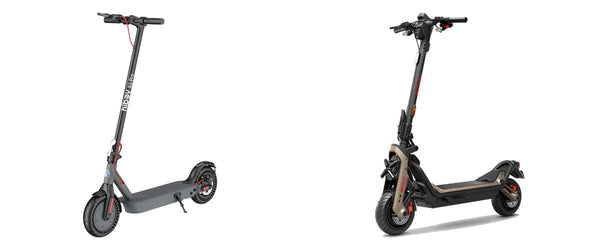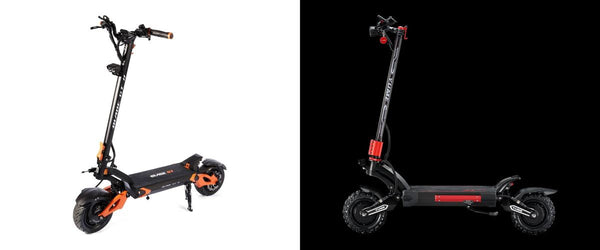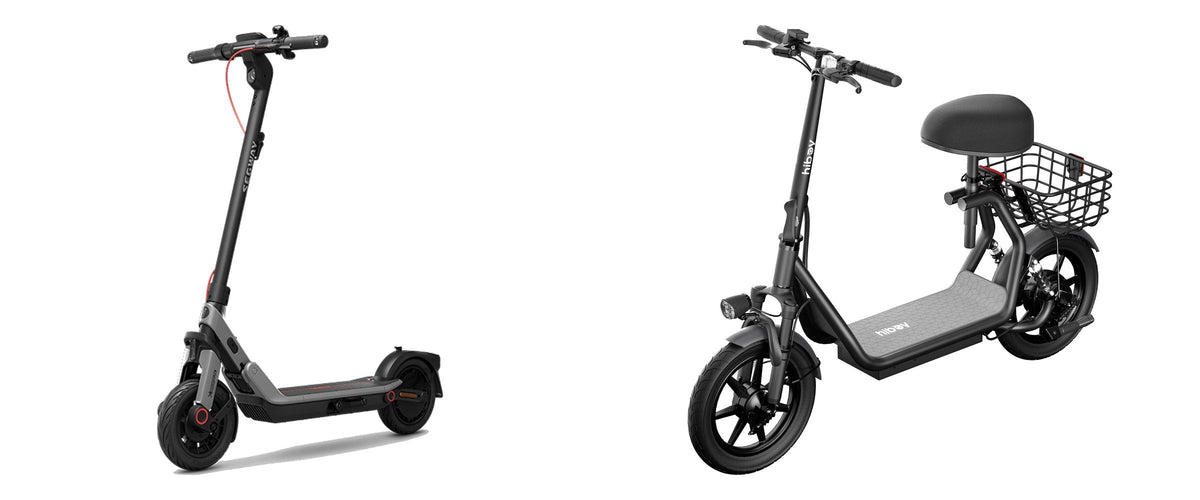
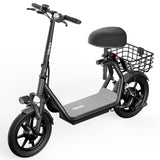
An electric scooter is a light, often folding ride you usually stand on, treated in most states as micromobility: in many places no license, plate or registration, and bike lanes are open to it. A moped is a seated motor vehicle with its own rules: in most states it needs registration, often a driver's license, and it may be kept out of bike lanes. For short city trips that mix with trains, stairs and bike lanes, an electric scooter fits better; for longer road trips at moped speeds where your state allows them, a moped does.
We sell and service electric scooters and e-bikes, and riders often ask us where an electric scooter ends and a moped begins. The line is set by each state, so this guide compares how the two ride and gives the rules in several states as examples.
Electric scooter vs moped at a glance
| Electric scooter | Moped | |
|---|---|---|
| How you ride | Standing on a deck; some models add a seat | Seated, with your feet on a floorboard or pegs |
| Speed rules | Often capped at 15 mph where you ride, as in New York City and California | State definitions run up to about 25 to 40 mph, depending on the state and class |
| License | Not needed in many states, including New York, Florida and Texas; California asks for a driver's license or permit | Often needed; North Carolina is one state that doesn't ask for one |
| Registration and plate | Not needed in many states, including New York, Florida and Texas | Usually required |
| Bike lanes | Usually allowed, and in New York City expected | Not in New York City; not on bicycle-only paths in Arizona |
| Carrying and storage | Many commuter models fold and weigh 25 to 45 lb | Parked like a motorcycle; too heavy to carry upstairs |
| Best for | Short city trips, last mile from the train, small apartments | Longer road trips at moped speeds, where your state allows them |
Rules from our state law guides, which cite each state's statutes; check your own state and city. General information, not legal advice.
What makes something a moped
Each state writes its own definition, usually some mix of a seat, the number of wheels, motor power and top speed. A few examples, as set out in our state guides:
- New York: a faster ride with a seat is a moped, which the law calls a "limited use motorcycle". It needs a DMV registration and a license, and only a model certified by its manufacturer can be registered. NYC DOT sorts mopeds into Class A, B and C, and every class needs a driver's license, a plate, a VIN and DMV registration. See electric mopeds in New York, New York State electric scooter laws and NYC e-bike laws.
- North Carolina: two or three wheels, no external shifting, a motor of 50 cc or less and a top speed of no more than 30 mph, and electric models count. Riders must be 16 or older and wear a motorcycle helmet, and the moped must be registered, but no driver's license or motorcycle endorsement is needed. See North Carolina e-bike laws.
- Arizona: a bicycle with a helper motor of 50 cc or less, no more than 1.5 brake horsepower and a top speed of 25 mph. Any class of driver license is valid, it registers for a $5 fee, and it can't use bicycle-only paths. See Arizona e-bike laws.
- Georgia: two or three wheels and no more than two brake horsepower. Riders must be 15 or older and need a license or permit. See Georgia e-bike laws.
- California: from January 1, 2027, a new state law renames the "motorized bicycle" a moped, with a new definition for road-legal mopeds. See California electric scooter laws.
For other states, see our state law guides.
What makes something an electric scooter
An electric scooter is a small electric ride with handlebars and a deck, built for short trips. States regulate them as their own category, with limits on speed, where you ride and rider age:
- New York City: 16 or older, 15 mph, bike lanes or streets posted 30 mph or less, never the sidewalk, and no license, plate or registration. To count as an electric scooter in New York, it must be built for 20 mph or less and weigh under 100 lb. See are electric scooters legal in NYC.
- California: a driver's license or instruction permit is needed, no one may ride one faster than 15 mph, and riders under 18 must wear a helmet. See California electric scooter laws.
- Florida and Texas: no license, registration or insurance. See Florida and Texas.
A seat doesn't make it a moped, and "e-bike" on the box doesn't make it an e-bike
Seated electric scooters sit between the two. In New York, the seated Hiboy U2 and Q2 fit the definition of an electric scooter on the maker's listed specs, because they are built for 20 mph or less and weigh under 100 lb. A seated ride that goes faster than that is often sold as a moped, and in New York it needs a license, a plate and registration and can't use bike lanes. See electric scooters with a seat.
The same goes for labels. Many fast electric two-wheelers sold online as e-bikes are mopeds under New York law, usually because the motor is 750 watts or more, or because they go faster than 25 mph under motor power. What the law looks at is how the machine is built, not what the listing calls it.
Electric motorbikes and electric dirt bikes are a different category again. See is a Surron street legal?.
Which fits your ride?
Choose an electric scooter if:
- Your trips are a few miles across town, or from the train to the office
- You need to carry it up stairs, onto a train or into an office
- You want to use bike lanes and skip the plate, registration and insurance where your state allows
- You want lower costs to buy and run; many good commuter models are under $1,000
Choose a moped if:
- Your trips are longer and on roads where moped speeds make sense
- You want to sit for the whole ride on a bigger, heavier frame
- You're ready for registration, a plate, and a license and insurance where your state requires them
- You have somewhere to park it at street level
Somewhere between: a seated electric scooter, like the Hiboy Q2 Seated or Hiboy U2, gives you a seat under electric scooter rules, and an e-bike gives you pedals and more range. See electric scooter vs e-bike.
Picking an electric scooter
If an electric scooter fits your trips, start with what you'll ride, how far, and where you'll keep it. Our guides by budget: under $500, under $1,000 and under $2,000; for New York City streets, the best electric scooters for commuting in NYC. To see what it costs overall, read how much an electric scooter costs.
Whatever you choose, our technicians service electric scooters and e-bikes of every brand at all six Wilson's shops, wherever you bought it. Looking it over and telling you what we find is always free; a tune-up and safety check starts from $50, brake repair from $25 and flat tire repair from $40, parts and labor included.
Frequently asked questions
Is an electric scooter a moped?
Not usually. Most states treat electric scooters as their own category, with no plate or registration. A seated ride that goes faster than your state's electric scooter limits can count as a moped; in New York, an electric scooter must be built for 20 mph or less and weigh under 100 lb.
Do you need a license for a moped?
Often, but it depends on the state. New York requires a license for every moped class; Arizona accepts any class of driver license; Georgia requires a license or permit; North Carolina requires none, but the moped must be registered.
Do you need a license for an electric scooter?
Not in many states, including New York, Florida and Texas. California requires a driver's license or instruction permit.
Can a moped use the bike lane?
Not in New York City, where mopeds of every class are kept out of bike lanes, and not on bicycle-only paths in Arizona. Electric scooters are usually allowed in bike lanes.
Which is faster, an electric scooter or a moped?
Some electric scooters are built to go faster than a moped, but where you ride sets the real limit: 15 mph in New York City and anywhere in California. Moped definitions run up to about 25 to 40 mph, depending on the state.
Which is cheaper to run?
Usually an electric scooter, where it needs no registration, plate or insurance. Charging costs little, and the main upkeep is tires, brakes and, after a few years, the battery.
Sources: state rules as set out in our state law guides, which cite New York Vehicle and Traffic Law §121-b, NY DMV and NYC DOT; N.C. G.S. 20-4.01(27), 20-7, 20-10.1, 20-53.4 and 20-140.4; A.R.S. 28-101 and 28-2513; O.C.G.A. 40-1-1 and 40-6-351; California Vehicle Code §§21235 and 22411 and SB 1167 (2026); Florida and Texas statutes. Checked November 2026. General information, not legal advice; check your state's official pages for the latest.