


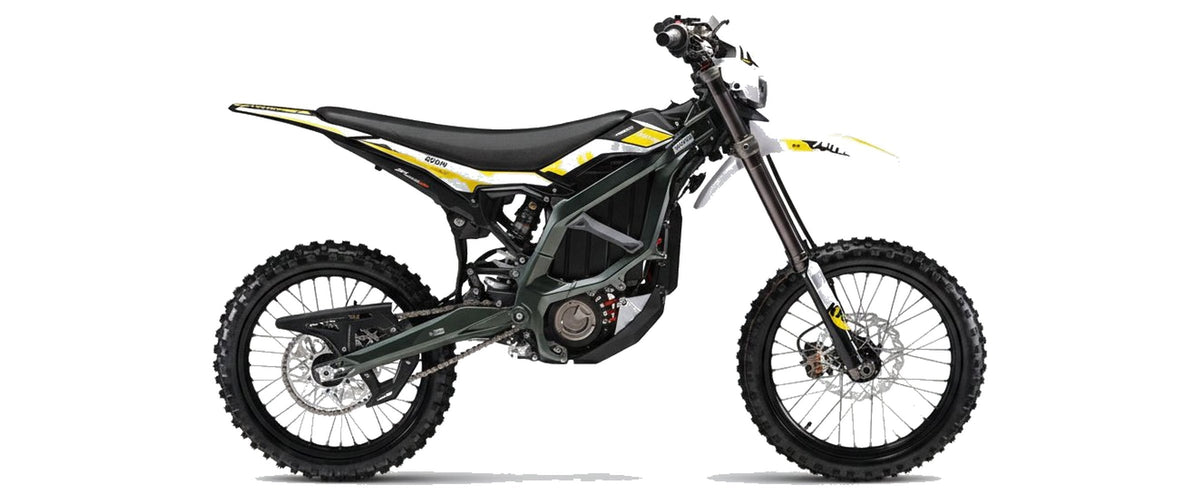


No. A Surron Light Bee X or Ultra Bee is built and sold as an off-road electric motorcycle, so it is not street legal as it comes, and it is not an e-bike in any state. A few states, including Washington, Nevada and Arizona, have a written process for putting an off-road-only motorcycle on the road. California says outright that Surrons can't be converted. In most other states we found no official process at all.
This guide sets out what each state's own agencies and statutes say, as of November 2026, and where you can ride a Surron legally today. It is general information, not legal advice: rules change, so check with your state's motor vehicle agency before you ride on any public road.
- As sold: off-road only. California State Parks, citing Surron's owner's manual, describes Sur-Ron electric motorcycles as made for off-highway use, not public roads.
- Not an e-bike: state e-bike laws cap the motor at about 750 W and assisted speed at 20 or 28 mph. California's own comparison chart lists the Light Bee X at 6,000 W peak and 47 mph, and the Ultra Bee at 12,500 W and 56 mph.
- Federal rules: a vehicle sold for off-road use is not certified to federal motor vehicle safety standards. NHTSA's position is that whoever converts an off-road motorcycle for the road is treated as its manufacturer, so a state plate is not the same as federal compliance.
Surron street-legal rules by state
| State | Road plates for a Surron? | Off-road riding on public land |
|---|---|---|
| California | No: the state names Sur-Ron and says it can't be made street legal | Green Sticker (OHV identification) |
| Washington | A state process exists for off-road-only motorcycles | ORV registration and decals |
| Nevada | A state process exists for off-road-only motorcycles | OHV registration |
| Arizona | A state process exists for off-highway vehicles | OHV decal |
| New York | No process found; State Police say most electric dirt bikes can't be street legal | DMV registration (off-road motorcycles count as ATVs) |
| Illinois | Not eligible if not built or equipped for highway use | OHV usage stamp |
| Texas | No conversion process found | Texas OHV decal |
| Florida | No conversion process found; off-road title only | Off-highway vehicle title |
| New Jersey | No conversion process found | MVC dirt bike registration |
| Pennsylvania | No conversion process found | No two-wheel registration found |
| Ohio | No full plating process found; limited road crossing only | BMV off-highway motorcycle registration |
| Michigan | No current process confirmed | DNR ORV license and trail permit |
| North Carolina | No process; a 2025 bill to allow it was not enacted | No statewide registration found |
| Georgia | No conversion process found | No statewide registration found |
From each state's motor vehicle agency, parks or OHV agency and statutes, checked November 2, 2026. "No process found" means we found no official route, not that one is guaranteed not to exist; ask your state's agency.
Why a Surron isn't an e-bike
Every state on this list defines an e-bike by its motor and its assisted speed: a motor of about 750 W or less, with motor help that stops at 20 mph (Class 1 and 2) or 28 mph (Class 3). New York's Class 3 stops at 25 mph and only applies in New York City. Pennsylvania adds a 100 lb weight limit. A Surron is far past every one of these limits, so it is classed as a motorcycle, an off-highway motorcycle or an off-road vehicle, never as an e-bike.
California has gone further. Vehicle Code 312.5(d), added by SB 1271, makes it illegal to sell or label as an e-bike any vehicle built to exceed 20 mph on the motor alone or 750 W. For more on the classes, see e-bike classes explained.
California
No road path. California State Parks' OHV Information Bulletin 25-1 (December 2025) names Sur-Ron and says these electric off-highway motorcycles can't be fitted with lights and other equipment to qualify for road registration, and can't be modified to become street legal. Riding one on a public road can bring a citation for an unregistered vehicle (Vehicle Code 4000(a)(1)) and for riding without the right license (12500(b)).
Off-road: a Green Sticker (OHV identification) is required on public land and on private land open to the public (Vehicle Code 38020 and 38170). From January 1, 2026, SB 586 added a definition of an off-highway electric motorcycle (Vehicle Code 436.1), and AB 875 lets police tow a non-e-bike electric vehicle that can exceed 20 mph and is ridden without a license (Vehicle Code 22651.08). See California electric scooter and e-bike laws.
Washington
A state process exists. The Department of Licensing's Off-Road Motorcycle Highway Use Declaration (form TD-420-808) is written for two-wheel motorcycles the maker labelled for off-road use only. A licensed Washington motorcycle dealer or repair shop inspects the lights, signals, reflectors, horn, mirror, brakes, tires and fenders, and certifies them; the owner needs a motorcycle endorsement. The plate and title are marked as modified for on-road use, and removing the equipment returns it to off-road only. The form doesn't mention electric motorcycles or motorcycles without a standard 17-digit VIN, so ask the DOL before you start.
Off-road: ORV registration and decals for trails and non-highway roads. Washington's e-bike definition excludes anything that can exceed 20 mph on the motor alone (RCW 46.04.169, tightened in 2026). See Washington e-bike laws.
Nevada
A state process exists. Nevada's OHV program says only two-wheel motorcycles can be converted to on-road use. The DMV's Motorcycle Highway Use Affidavit (form VP-254) covers two-wheel motorcycles not originally equipped or certified for public roads: a licensed Nevada motorcycle dealer or registered repair shop completes part of the form, the owner certifies the equipment meets state and federal rules, and the title is permanently branded as reconstructed. Electric motorcycles aren't addressed, so check with the DMV first.
Off-road: OHV registration under NRS chapter 490, with exemptions such as riding only on your own land.
Arizona
A state process exists. Under A.R.S. 28-1177, an Arizona resident who buys the OHV decal can register an off-highway vehicle for highway use if it meets highway equipment requirements, signing an affidavit to that effect. Arizona State Parks describes two paths, street legal or off-highway, and lists dirt bikes and trail motorcycles as OHVs; an Arizona title in your name is required. Inspection details aren't published there; Arizona State Parks points riders to MVD.
Off-road: the OHV decal is required for off-highway vehicles of 2,500 lb or less on public land.
New York
No process found. New York State Police say electric dirt bikes are off-highway motorcycles under state law, not legal on public roads, sidewalks, bike paths or parks unless fully registered, insured and street legal, and that most recreational models don't meet that. New York's definition of an off-highway motorcycle (Vehicle and Traffic Law 125-a) turns on a motorcycle not having road equipment, and we found no DMV process for converting one.
Off-road: the DMV treats an off-road motorcycle as an ATV, which must be registered to ride in New York, with insurance except on your own land. Surrons and other models over 20 mph aren't sold or shipped to New York City addresses. Where you can ride one is in where to ride electric dirt bikes in New York, and the wider rules in New York State electric scooter and e-bike laws.
Illinois
Not eligible as built. Illinois Vehicle Code section 3-101 says a cycle not properly manufactured or equipped for highway use isn't eligible for registration; it gets a distinctive certificate of title instead.
Off-road: an OHV usage stamp is required to ride an off-highway vehicle in Illinois (20 ILCS 862/26). See Illinois e-bike laws.
Texas
No conversion process found. Texas bars highway registration of an off-highway vehicle even if altered (Transportation Code 502.140 and 551A.052), but its definition of that term covers ATVs, recreational off-highway vehicles, utility vehicles and sand rails, not two-wheel motorcycles. TxDMV requires the maker's certificate of origin for an off-highway motorcycle to say it is for off-highway use only. We found no TxDMV route for converting one.
Off-road: Texas Parks and Wildlife requires the Texas OHV decal on non-street-legal motorcycles ridden on public land. Texas e-bikes stop at 28 mph and under 750 W (Transportation Code 664.001). See Texas electric scooter laws.
Florida
No conversion process found. Florida covers off-highway motorcycles under its Off-Highway Vehicle Titling Act (chapter 317): they get an off-road title, not a plate. We found no state process for converting one to road use.
Off-road: an off-highway motorcycle must be titled if it is ridden on public lands (section 317.0006), and on public lands it needs working brakes, a muffler and a spark arrester, with riders under 16 supervised (section 261.20). Florida e-bikes stop at 20 or 28 mph with a motor under 750 W (section 316.003).
New Jersey
No conversion process found. New Jersey law defines a dirt bike as a two-wheel motorcycle designed for off-road use only that doesn't meet federal on-road safety or emissions standards, which describes a Surron. We found no MVC process for putting one on the road.
Off-road: dirt bikes must be registered with the MVC, and insured to ride on public land. New Jersey's 2025 e-bike law, enforced by the MVC from June 2026, now registers low-speed electric bicycles and motorized bicycles; a Surron fits neither category. See New Jersey e-bike laws.
Pennsylvania
No conversion process found. PennDOT says devices not defined in the Vehicle Code may not be ridden on highways, sidewalks or bike lanes. Its electric-assist pedalcycle (the state's e-bike) must weigh under 100 lb, have a motor of 750 W or less and stop at 20 mph on the motor alone. A Surron is neither, and we found no PennDOT process for converting an off-road motorcycle.
Off-road: DCNR registers ATVs; we found no state registration for two-wheel off-road motorcycles. See Pennsylvania electric scooter laws.
Ohio
No full plating process found. Ohio's BMV allows an off-highway motorcycle only limited road use: crossing roads that aren't limited-access, riding on county or township roads where local authorities allow it, and travelling alongside the road from where it was unloaded. Any road or public land use needs a license or motorcycle endorsement.
Off-road: off-highway motorcycles must be titled and registered with the BMV, with a three-year decal (Ohio Revised Code 4519.02). See Ohio e-bike laws.
Michigan
No current process confirmed. We found no Secretary of State process for registering an off-road motorcycle for the road.
Off-road: the DNR requires an ORV license to ride on state, county and national forest roads open to ORVs, plus a trail permit on state-designated ORV trails. Michigan e-bikes are limited to 750 W (MCL 257.13e). See Michigan e-bike laws.
North Carolina
No process. A 2025 bill, H847, would have let certain off-road motorcycles with highway equipment register as motorcycles, but the last record shows it in a Senate committee, not enacted. North Carolina's electric assisted bicycle stops at 20 mph on the motor alone with a motor of 750 W or less.
Off-road: we found no statewide OHV registration. See North Carolina e-bike laws.
Georgia
No conversion process found. Georgia's road registration program for multipurpose off-highway vehicles excludes dirt bikes and other straddle-seat vehicles with fewer than four wheels, and we found no Department of Revenue process for converting an off-road motorcycle.
Off-road: we found no statewide OHV registration for dirt bikes. See Georgia e-bike laws.
Can you make a Surron street legal with a kit?
Adding lights, mirrors, signals and a horn doesn't by itself make an off-road motorcycle street legal. In the states with a process, the state still has to inspect and register it; Nevada's DMV notes that adding equipment alone doesn't make an off-road-only vehicle eligible. Federally, NHTSA treats the person who converts it as the manufacturer responsible for meeting federal safety standards. We found no official street-legal Surron model or kit sold in the US.
A plated motorcycle in any state also comes with the usual motorcycle obligations: registration, insurance, a motorcycle license or endorsement and a DOT helmet.
Where can you ride a Surron legally?
- Private land, with the owner's permission.
- Public OHV areas and trails that allow off-road motorcycles, with your state's off-road registration, decal or stamp from the table above.
- Not on public roads, sidewalks, bike lanes or parks in most states, unless the electric dirt bike has been put through a state process and plated.
Buying and servicing a Surron at Wilson's
We sell the Surron Light Bee X and Surron Ultra Bee as off-road electric dirt bikes; see the product pages for today's prices. To choose between them, read Light Bee X vs Ultra Bee, or compare brands in Surron vs Talaria and the best electric dirt bikes.
Our technicians service Surron, Talaria and every other electric dirt bike, electric scooter and e-bike, wherever you bought it, at our shops in New York City, San Francisco and Miami. A simple inspection is always free. Walk in, or book a repair at our New York and San Francisco shops.
Frequently asked questions
Is a Surron street legal?
Not as sold. Surrons are built and sold as off-road electric motorcycles. A few states, including Washington, Nevada and Arizona, have a process for putting an off-road-only motorcycle on the road; California says Surrons can't be converted.
Is a Surron an e-bike?
No. State e-bike laws cap the motor at about 750 W and assisted speed at 20 or 28 mph. California lists the Light Bee X at 6,000 W peak and 47 mph.
Can you get a Surron plated in California?
No. California State Parks' 2025 bulletin names Sur-Ron and says these electric dirt bikes can't be modified to become street legal. Off-road, they need a Green Sticker.
Can you make a Surron street legal in Texas or Florida?
We found no official conversion process in either state. Texas requires its OHV decal on non-street-legal motorcycles on public land; Florida requires an off-highway vehicle title to ride on public lands.
Do you need a license to ride a Surron?
Off-road on private land, usually not, but your state's off-road registration rules still apply on public land. On a public road it would need to be registered and plated as a motorcycle, which needs a motorcycle license or endorsement.
Where can I ride a Surron?
On private land with permission, and on public OHV areas and trails that allow off-road motorcycles, with your state's off-road registration.
Sources, checked November 2, 2026: California State Parks OHV Information Bulletin 25-1 (Dec 2025), California Vehicle Code 312.5, 436.1, 4000, 12500, 22651.08, 38020, 38170; Washington DOL form TD-420-808 and RCW 46.04.169; Nevada OHV program and DMV form VP-254, NRS 490; A.R.S. 28-1177 and Arizona State Parks OHV registration; New York State Police notice (June 2026), NY DMV ATV registration and VTL 102-c, 125-a; 625 ILCS 5/3-101 and 20 ILCS 862/26; Texas Transportation Code 502.140, 551A.052, 664.001, TxDMV title manual and Texas Parks and Wildlife OHV program; Florida Statutes 261.20, 316.003, chapter 317; NJ MVC Advisory 2026-02 and P.L.2009 c.275; PennDOT PUB 944; Ohio BMV 3709 and ORC 4519.02; MCL 257.13e and Michigan DNR ORV rules; NC H847 (UNC School of Government summary); Georgia DOR multipurpose off-highway vehicle registration; 49 U.S.C. 30102 and NHTSA interpretations. This guide is general information, not legal advice.


