




Yes, you can ride an e-bike in winter. The cold costs you range, and most makers won't let you charge a frozen battery, but riding in the cold doesn't hurt the battery. The real risks are ice, slush, darkness at 5 PM and road salt. Here is what the makers say about cold batteries, how to ride when it's slick, and what our technicians clean and check once winter has had its way with your e-bike.
Never charge a battery that is wet, swollen, cracked or was dropped hard. If your e-bike's brakes feel weak or grab unevenly after a salty week, or the motor cuts in and out in wet weather, stop riding it and bring it to a shop.
What cold weather does to an e-bike battery
Lithium-ion batteries give less in the cold, so your range drops on a freezing morning and comes back as the battery warms up. Giant, one of the largest e-bike makers, says riding in the cold does no lasting harm to the battery; you simply get less range in winter. Charging is where the makers draw hard lines. Here is what two Segway manuals and Giant's winter guidance say:
| Maker and source | Riding or operating | Charging | Storage |
|---|---|---|---|
| Segway Xafari user manual | -4 to 122°F (-20 to 50°C) | Only at 32 to 104°F (0 to 40°C) | -4 to 122°F (-20 to 50°C) |
| Segway Myon product manual | 32 to 104°F (0 to 40°C) | 32 to 104°F (0 to 40°C) | -4 to 122°F (-20 to 50°C) |
| Giant, e-bike battery care in winter | Cold does no lasting harm; expect less range | Let the battery reach room temperature first | Indoors, at around 60% charge |
Segway Xafari user manual and Myon product manual (segway.la) and Giant Bicycles UK, read November 23, 2026. Your own e-bike's manual is the final word for your model.
Two things stand out. First, the limits differ even between two e-bikes from the same maker: one Segway manual allows riding well below freezing, the other lists freezing as its lower operating limit. Second, every source agrees on charging: not below freezing. A battery that comes in from a frozen street should warm up indoors before it goes on the charger. If your e-bike's battery lifts out, the makers' advice is simple: bring it inside between rides.
For how much range to expect and why, see range in cold weather, and for e-bike range in general, how far an e-bike can go.
How to ride an e-bike on cold, wet and icy roads
Slow down, and leave twice the room to stop
Wet leaves, slush, painted lines, steel plates, manhole covers and subway grates are all slicker than they look in winter, and an e-bike carries more weight than a pedal bicycle, so it takes longer to stop. Ride slower than you would in summer, leave more space to the vehicle ahead, and start braking earlier and more gently, with both brakes, while you're still upright and rolling straight.
Use a lower assist level on slick surfaces
A strong motor can spin the rear tire on ice or wet paint when you pull away. Starting in a low assist level, or easing onto the throttle, keeps the tire gripping. Save the high assist levels for dry, clear stretches.
Turn smoothly, and don't lean on ice
Do your braking before the corner, then turn with the e-bike more upright than usual. If you see ice, ride across it straight and steady rather than braking or turning on it. Black ice forms first on bridges, overpasses and shaded streets, so treat those as icy on any cold morning.
Snow: know when to walk it
Fresh, packed snow can be rideable on wide tires at low speed. Deep slush, ruts and refrozen tracks are not; they grab the front wheel. When the street hasn't been plowed, walk the e-bike or take the train. No commute is worth a fall on a heavy e-bike.
Dress for the wind you make
At 15 to 20 mph, a 35°F morning feels far colder than it does standing still. Layers that unzip, a windproof outer shell, warm gloves that still let you feel the brake levers, and something over your ears under the helmet make a bigger difference than one heavy coat. Cold fingers brake late, so the gloves are a safety item, not just comfort.
Be seen on short winter days
In New York in December, it is dark before most people leave work, so nearly every winter commute home is a night ride. A bright headlight, a red tail light, and reflective details on your clothing and e-bike help drivers see you through rain, snow and windshield fog. Many states, including New York, set rules on lights for e-bikes after dark; see night riding light rules.
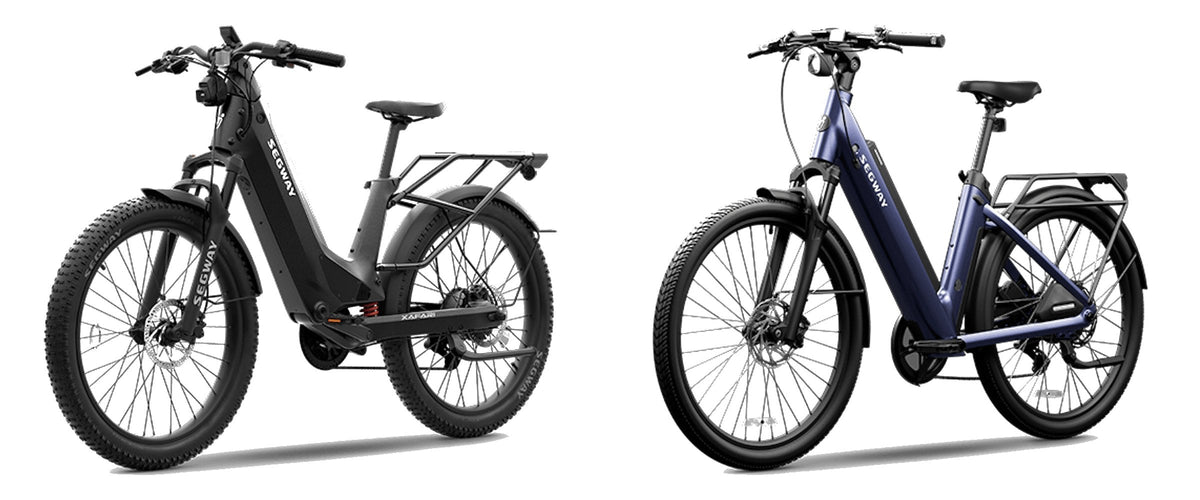
Some e-bikes make this easier. The Segway Myon has a 600-lumen headlight that adjusts to the ambient light, built-in turn indicators and a tail light that brightens when you brake.
Rain, slush and water ratings
Winter riding is wet riding: rain, melting snow and spray from every car. Most e-bikes are built to handle rain, and many carry an IP water rating, but no e-bike is meant to be submerged, and slush is sneaky because it packs into the motor, connectors and brakes and then refreezes overnight. For what the ratings mean, read riding in the rain or snow. If water ever gets into your e-bike and it starts acting up, that's a job for our technicians, from $50 for water and salt damage.
Which e-bikes handle winter best?
Wide tires help most. A fat tire e-bike puts more rubber on the ground, which gives more grip and stability on slush, packed snow and gravel. The Hiboy P6 rides on 26 x 4 inch puncture-resistant fat tires that Hiboy says suit city, snow, sand and dirt. The Segway Xafari pairs 26 x 3.0 inch all-terrain tires with an automatic 1300-lumen headlight, and Segway rates its battery IPX7 and its body IPX5.
Beyond tires, look for hydraulic disc brakes, which keep their bite better in the wet, a removable battery you can bring inside, built-in lights, and fenders that keep slush off you and the drivetrain. Browse our fat tire e-bikes or every electric bike we carry.
Road salt: what we clean and check after winter riding
Road salt is the quiet winter problem. It sticks to the chain, the brake rotors and calipers, the connectors and every bolt, and it keeps working long after the ride. A winter of salt can turn a quiet drivetrain into a crunchy one, glaze the brakes, and creep into wiring. Here is what our technicians clean and inspect, and what it costs:
| Service | What our technicians do | From |
|---|---|---|
| Simple inspection | Look it over and tell you what we find, any brand | Free |
| Winter cleanup and storage prep | Clean off salt and grime, inspect for corrosion, ready it for more riding or for storage | $30 |
| Tune-up and safety check | Brakes, drivetrain, tires, bolts, lights and battery connections inspected and adjusted | $50 |
| Water and salt damage | Open up and dry out wet electronics, clean corroded connectors, test the systems | $50 |
| Brake repair | Pads, disc cleaning and clearance, with a bearing inspection | $25 |
| Chain and drivetrain replacement | Replace a chain or drivetrain parts that salt has worn out | $45 |
| Headlight and taillight repair | Lights that flicker or quit in the wet | $35 |
Wilson's starting prices, parts and labor included; the final price depends on the model and the part. A full diagnosis with disassembly or test equipment is $30, waived if the repair comes to more than $100. More prices in how much does e-bike repair cost.
When an e-bike comes in after a salty stretch, we look at the brakes first, because glazed pads and salty rotors are the safety issue. Then the chain and gears, then the charging port and the battery and motor connectors, where corrosion turns into intermittent power cuts. A mid-winter cleanup and a spring tune-up are usually enough for a daily rider.
Riding all winter, or parking it until spring?
If you're putting your e-bike away for the season, the storage rules are different from riding rules: charge level, where to keep it and how often to top it up. Our guide to winter storage covers that. Either way, a winter cleanup from $30 before it goes away keeps salt from sitting on the parts all season.
Where to get your e-bike winter-ready
Bring it to any Wilson's shop: Flushing, Elmhurst, Brooklyn and Long Island City in New York City, San Francisco, or Miami (walk-ins only). Flushing, Elmhurst and Miami are open Sundays. Walk in, call (516) 300-0944, or book a repair at the New York and San Francisco shops. We service any brand, wherever you bought it; see e-bike repair in NYC.
Frequently asked questions
Can you ride an e-bike in the snow?
On packed snow at low speed, with wide tires, yes. In deep slush, ruts or on ice, walk it. Use a low assist level and brake early and gently.
Is it bad to ride an e-bike in the cold?
Giant says riding in the cold does no lasting harm to the battery; you just get less range. Your own manual gives its operating range: Segway's Myon manual lists 32°F as its lower limit.
Can I charge my e-bike battery in the cold?
Not below freezing. Both Segway manuals say charge only between 32 and 104°F, and Giant says to let the battery reach room temperature first.
Why does my e-bike lose range in winter?
Cold lithium-ion batteries deliver less energy, and winter riding means headwinds, lights on and slower, heavier tires. The range comes back as the weather warms.
Does road salt damage an e-bike?
It can corrode the chain, brakes, bolts and electrical connectors over a season. Our winter cleanup starts from $30, and water and salt damage repair from $50.
Do I need a tune-up after winter?
For a daily winter rider, a spring tune-up from $50 is a good idea: brakes, drivetrain, tires and connections all get inspected.
Sources: Segway Xafari user manual and Segway Myon product manual (segway.la), Giant Bicycles UK winter battery guidance, read November 23, 2026; Hiboy P6, Segway Myon and Segway Xafari product pages; Wilson's repair price list. General riding information, not a substitute for your e-bike's manual or local traffic rules.


