


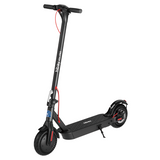

In Oregon, neither an e-bike nor an electric scooter needs a driver's license, registration or insurance. Today you must be 16 to ride either one, electric scooter riders must keep to 15 mph and wear a helmet at every age, and neither may be ridden on the sidewalk. On January 1, 2027, a new state law lowers the electric scooter age to 14, raises its speed limit to 20 mph, limits the helmet rule to riders under 16, and lets 14- and 15-year-olds ride Class 1 e-bikes. Here's what the statutes say, statewide.
Oregon e-bike and electric scooter rules at a glance
| E-bike | Electric scooter | |
|---|---|---|
| What counts | Class 1, 2 or 3; no wattage limit in the definition | Motor of 1,000 watts or less that can't push it past 24 mph on level ground (20 mph from 2027) |
| Driver's license | Not required | Not required |
| Registration and insurance | Not required | Not required |
| Speed | Motor help stops at 20 mph (Class 1 and 2) or 28 mph (Class 3) | 15 mph limit; 20 mph from 2027 |
| Minimum age | 16; from 2027, 14 for Class 1 | 16; 14 from 2027 |
| Helmet | Required under 16 | Every rider; from 2027, under 16 |
| Sidewalks | Never | Only to enter or leave a property |
| Passengers | Only as many as it's designed for | None |
The rules come from the Oregon Revised Statutes and House Bill 4007, signed on April 7, 2026, which takes over on January 1, 2027. Sources are listed at the end.
What are the e-bike classes in Oregon?
- Class 1: the motor helps only while you pedal, and stops helping at 20 mph.
- Class 2: the motor can move the e-bike without pedaling, and stops helping at 20 mph.
- Class 3: the motor helps only while you pedal, and stops helping at 28 mph. It must have a speedometer.
Since a 2024 update, Oregon's definition sets no wattage limit for the motor, so a guide that quotes one for e-bikes is out of date. What matters is the class. Oregon treats an e-bike as a bicycle rather than a motor vehicle, so on the road you follow the bicycle rules. For how the classes compare across states, see e-bike classes explained.
Do you need a license for an e-bike or electric scooter in Oregon?
No. Oregon law lets you ride a Class 1, 2 or 3 e-bike, or an electric scooter that fits the state's definition, without any driver's license or permit. Bicycles, which include e-bikes, are exempt from title and registration, electric scooters are exempt from registration, and electric scooters are exempt from the state's insurance rules too.
The age is the catch. Until December 31, 2026, you must be 16 or older to ride either one without a license. From January 1, 2027:
- Class 1 e-bike: 14 and older.
- Class 2 and Class 3 e-bikes: 16 and older.
- Younger riders: may ride a Class 1 or Class 2 e-bike while taking part in an approved bicycle safety program.
- Electric scooter: 14 and older.
How fast can you ride an electric scooter in Oregon?
Today the limit is 15 mph. From January 1, 2027 it rises to 20 mph, and the definition tightens: to count as an electric scooter, its motor must be 1,000 watts or less and unable to push it past 24 mph on level ground today, or 20 mph from 2027.
The definition covers electric scooters with a foot support or a seat, on up to four wheels, so seated models can count too.
Where can you ride an electric scooter in Oregon?
- Use the bike lane. Where a bike lane or bicycle path runs next to the road, you must use it, unless a local ordinance bans electric scooters there.
- Roads over 25 mph: you may not ride in the traffic lane of a road with a speed limit over 25 mph. On those roads, stay in the bike lane, or just cross.
- Ride right when slower than traffic, except to pass, turn left or avoid hazards.
- Sidewalks: no, except to enter or leave a property next to it, and then yield to pedestrians.
- Crosswalks: walk the electric scooter across.
- Signals and passengers: give hand signals when it's safe to take a hand off, and carry no passenger.
On paths and in bike lanes, yield to pedestrians and warn them before passing. Cities can add their own rules; Portland's are in our Portland commuting guide.
Where can you ride an e-bike in Oregon?
E-bikes ride on the road with the same rights and duties as a bicycle. Where the road authority has found an adjacent bike lane or path suitable, you generally have to use it, except to pass, turn or avoid hazards. An e-bike may never be ridden on a sidewalk in Oregon, even where a pedal bicycle may. For lights after dark, see night riding light rules.
Can you ride an e-bike in Oregon state parks?
Yes, on more trails than before. Since July 1, 2025, Oregon Parks and Recreation allows Class 1, 2 and 3 e-bikes on trails wherever other bicycles are allowed, unless a trail is posted as closed to them. Before that, e-bikes were limited to trails at least 8 feet wide.
- Ocean shore: e-bikes may ride on wet sand, except where restricted. They're not allowed on dry sand, dunes or anything above the high-tide line, or on wet sand in snowy plover nesting areas from March 15 to September 15.
- Closed trails: at the time of the 2025 rule, the department listed all trails at Elijah Bristow State Park, the equestrian trails and Vision Trail at Willamette Mission State Park, the Riverside Trail at Clyde Holliday State Recreation Site and the Lewis and Clark Trail at Emigrant Springs State Natural Area. Watch for signs, since park managers can close more.
- Out-of-class e-bikes: anything that isn't a Class 1, 2 or 3 e-bike, or has been modified out of its class, counts as a motor vehicle in state parks and is kept off trails.
Yield to pedestrians, horses and animals, and walk your e-bike in crowded areas. Rangers can write citations, with fines starting at $100 for serious or repeated violations. State law also lets the parks department restrict electric scooters on bicycle paths in state parks.
Do you need a helmet on an e-bike or electric scooter in Oregon?
Until December 31, 2026, anyone under 16 must wear an approved helmet on a bicycle, including an e-bike, and every electric scooter rider must wear one, at any age. The fine is $25, and a first offense can be excused if you show the court you own an approved helmet.
From January 1, 2027, the all-ages electric scooter rule goes away. Instead, one rule covers riders under 16 on bicycles, e-bikes, electric scooters and the new powered micromobility devices: a parent or guardian who lets a child under 16 ride without a helmet, or a rider who carries a passenger under 16 without one, can be fined $25. We'd wear a helmet at every age either way. See our helmets and safety gear.
What changes on January 1, 2027?
Besides the age, speed and helmet changes above, House Bill 4007 adds three things worth knowing before you buy:
- Powered micromobility devices. A new category for anything with a motor that tops out at 28 mph and weighs under 100 pounds, other than an e-bike, electric scooter, moped or motorcycle. Riders must be 16, follow the bicycle rules and need no registration, but cities and state agencies may ban these devices from bike lanes, paths, sidewalks and trails. A light electric scooter faster than 20 mph is likely to land here.
- Certified batteries and chargers. Selling an e-bike or electric scooter battery or charging system that an accredited testing lab hasn't certified becomes a violation. Our UL 2849 vs UL 2272 guide explains what those certifications cover.
- Impostor vehicles. Selling something as an e-bike or electric scooter when it doesn't fit the definition, or one built to be switched past the class it's sold as, becomes a violation. If an e-bike's class can be changed in an app or menu, ask the seller how it's set.
What about faster electric scooters and e-motos?
An electric scooter with more than 1,000 watts, or one that can go faster than the definition allows, isn't covered by Oregon's electric scooter rules. Depending on its design, it may be a moped, which the DMV titles and registers and which needs a driver's license of any class, or a motorcycle. Electric dirt bikes and e-motorbikes aren't e-bikes either. Ask the Oregon DMV how it treats your model before you ride it on a public road. Our guide to electric scooters vs mopeds explains the difference.
Which of our rides fit Oregon's rules?
For an electric scooter, look for a motor of 1,000 watts or less and a top speed of 20 mph or less, so it stays legal before and after 2027. Until then, keep to 15 mph on the road. Figures are the makers', from our product pages:
| Ride | Motor (maker) | Top speed (maker) | Oregon category |
|---|---|---|---|
| Hiboy S2 Pro electric scooter | 500W rated, 600W peak | 19 mph | Electric scooter, now and from 2027 |
| Hiboy KS4 Pro electric scooter | 500W, 750W peak | 19 mph | Electric scooter, now and from 2027 |
| Segway F3 electric scooter | 450 W nominal, 1000 W max | Approx. 20 mph | Electric scooter, right at the 1,000-watt line |
| Hiboy C1 folding e-bike | 350W rated, 648W peak | 20 mph on the throttle or pedal assist | Class 2 e-bike: riders 16 and up |
| Segway Xafari fat tire e-bike | 750W | Class 2 at 20 mph, Class 3 at 28 mph | E-bike: riders 16 and up |
Because Oregon sets no wattage cap on e-bikes, a 750-watt e-bike like the Xafari is fine as long as it's ridden as a Class 2 or Class 3. On the other side, the Segway Max G3 electric scooter has a 2000 W max power and reaches up to 28 mph with its high-speed mode enabled, so it's outside Oregon's electric scooter definition. Bought from us, each ride has a one-year Wilson's warranty against manufacturing defects, and we manage the claim with the maker. Standard shipping is free to Oregon and the rest of the lower 48 (see our shipping policy). Browse commuter electric scooters or commuter e-bikes.
Where can Oregon riders get service?
We don't have a shop in Oregon. Our shops are in New York City, San Francisco and Miami, and our technicians service every brand of electric scooter and e-bike, wherever you bought it, with express service at every shop. A simple inspection is always free; a full diagnosis with disassembly or test equipment is $30, waived on repairs over $100. Starting prices, parts and labor included: brake repair from $25, flat tire repair from $40, tune-up and safety check from $50. Water and salt damage repair starts from $50, and never charge a wet or swollen battery: bring it straight in. Book a repair.
Riding across the state line? See our Washington and California guides, or all our state law guides.
Frequently asked questions
Are electric scooters legal in Oregon?
Yes, with no license or registration, if its motor is 1,000 watts or less and it can't go past 24 mph on level ground (20 mph from 2027). Riders must be 16 (14 from 2027), keep to 15 mph (20 mph from 2027) and stay off sidewalks.
How old do you have to be to ride an e-bike in Oregon?
16 for every class until December 31, 2026. From January 1, 2027, 14 for a Class 1 e-bike and 16 for Class 2 and Class 3, with an exception for younger riders in an approved bicycle safety program.
Can you ride an e-bike on the sidewalk in Oregon?
No. Oregon law makes riding an e-bike on any sidewalk a traffic violation. Electric scooters may use the sidewalk only to enter or leave a property next to it.
Do you need a helmet on an electric scooter in Oregon?
Yes, at every age, until December 31, 2026. From January 1, 2027, the helmet rule covers riders under 16, and the fine falls on the parent or guardian.
Sources: Oregon Revised Statutes, 2025 edition: chapter 801 (801.258 e-bikes, 801.345 mopeds, 801.348 electric scooters) and chapter 814 (814.405 to 814.488 bicycles and e-bikes, 814.510 to 814.536 electric scooters); Oregon Laws 2026, chapter 101 (House Bill 4007), including the amended ORS 803.305, 806.020 and 807.020; Oregon Parks and Recreation Department, administrative order PRD 5-2025 and news release on new e-bike rules, July 8, 2025; Oregon DMV, Bicycle Manual and Motorcycle and Moped Manual. Checked November 23, 2026.
This guide is general information, not legal advice. Laws and city rules change, so check the current rules before you ride.


