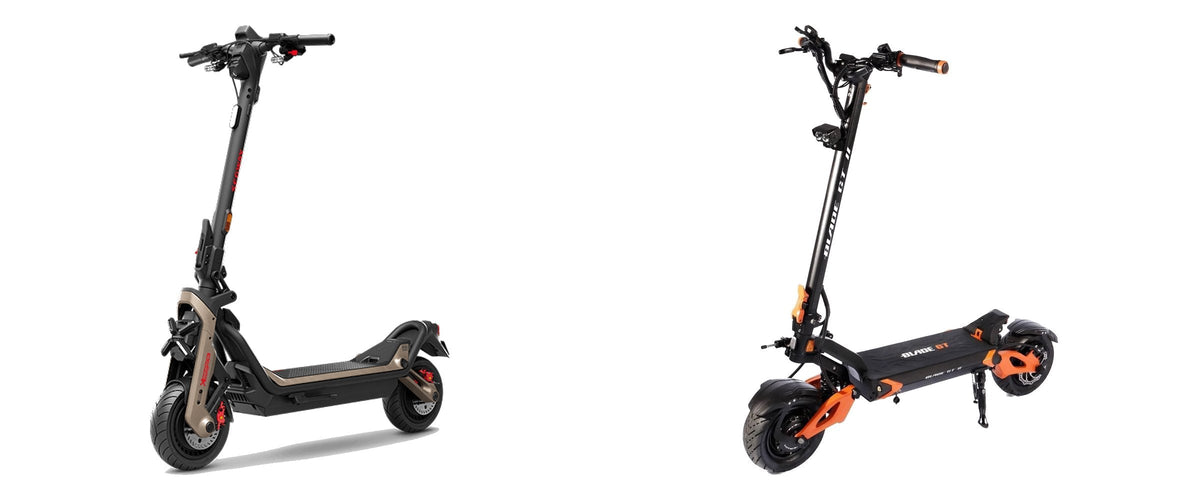
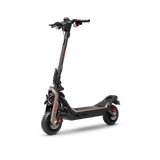
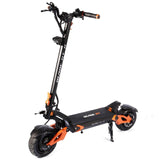
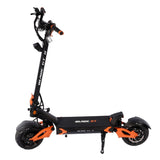
The Segway GT3 Pro and the Teverun Blade GT II are both folding dual-motor electric scooters on 11-inch self-sealing tubeless tires, rated around 50 mph, with hydraulic disc brakes and traction control. The Blade GT II is the lighter one at 95 lb and costs a band less, in the $1,000–$2,000 band at Wilson's. The GT3 Pro, in the $2,000–$3,000 band, carries a much bigger 72V battery, more motor power, adjustable hydraulic suspension and anti-lock brakes, at about 117 lb. Teverun's Blade GT II+ sits between them: the Blade frame with a bigger battery and adjustable hydraulic suspension, priced like the GT3 Pro. None of the three is sold or shipped to New York City addresses.
Segway GT3 Pro vs Teverun Blade GT II at a glance
| Segway GT3 Pro | Teverun Blade GT II | Teverun Blade GT II+ | |
|---|---|---|---|
| Top speed | About 50 mph | Up to 53 mph | Up to 53 mph |
| Range (maker) | About 86 miles in Eco, 45 in Sport, 34 in Race | Up to 50 miles | Up to 62 miles |
| Motors | Front and rear hub, 1,700W nominal and 3,500W max each | Dual hub, 4,900W peak | Dual 1,600W hub, 4,900W peak |
| Battery | 72V 30Ah, 2,160 Wh | 60V 26Ah | 60V 35Ah Samsung |
| Brakes | Hydraulic discs, dual-piston, 140 mm ventilated rotors, anti-lock (S-ABS) | Full hydraulic discs, front and rear | Full hydraulic discs, front and rear |
| Suspension | Front double-wishbone hydraulic shock, 15 stiffness levels; rear trailing-arm hydraulic shock | Spring, front and rear, plus steering damper | KKE adjustable hydraulic, front and rear, plus steering damper |
| Traction control | Yes (TCS) | Yes (TCS, app-switchable) | Yes (TCS) |
| Tires | 11-inch self-sealing tubeless | CST 11-inch tubeless, self-sealing | CST 11-inch (90/65-6.5) tubeless, self-sealing |
| Climbing (maker) | About 38% slope | 35° | 35° (same frame) |
| Display | 2.4-inch color TFT with navigation | 3-inch TFT with NFC | 3-inch TFT with NFC |
| Charger | 332W (84V, 4A), about 8 hours | 5A fast charger; time not published | 67.2V 5A; time not published |
| Water rating | IPX6 body, IPX7 battery | IP67 wiring and cables | IP67 wiring |
| Weight | About 117.1 lb | 95 lb | 97 lb |
| Max rider weight | 330 lb | Not listed on our page | 265 lb |
| Price band* | $2,000–$3,000 | $1,000–$2,000 | $2,000–$3,000 |
*Price band from our current prices; prices change often, so each product page shows today's price. Specs are Segway's and Teverun's manufacturer figures, as listed on our Segway GT3 Pro, Teverun Blade GT II and Teverun Blade GT II+ product pages, read November 2, 2026. Range and speed vary with rider weight, terrain, temperature and riding style.
Which is cheaper?
The Blade GT II, by a full band: it sells in the $1,000–$2,000 band at Wilson's, against $2,000–$3,000 for the GT3 Pro. The Blade GT II+, with the bigger battery and hydraulic suspension, is in the same $2,000–$3,000 band as the GT3 Pro. All three ship free to the lower 48 states and Washington, D.C., except New York City addresses, and checkout takes card, Shop Pay, Apple Pay or Google Pay; see ways to pay.
Which is faster?
On paper the Blade GT II, at up to 53 mph against about 50 mph for the GT3 Pro. In practice that's a small gap at speeds most riders rarely hold. Segway quotes 0 to 30 mph in 3.9 seconds for the GT3 Pro, from two motors that each reach 3,500W; Teverun rates the Blade's two motors at 4,900W peak combined. Both have speeds far over the 20 mph limit New York sets for electric scooters, so they are ridden where local rules allow. See the fastest electric scooters and electric scooter laws in NYC.
Which goes farther?
The GT3 Pro has the much bigger battery: 72V 30Ah, or 2,160 Wh, against 60V 26Ah on the Blade GT II and 60V 35Ah on the GT II+. Segway rates it by riding mode, at about 86 miles in Eco, 45 in Sport and 34 in Race; Teverun rates the Blade GT II at up to 50 miles and the GT II+ at up to 62. The makers don't test the same way, so treat the headline numbers as a rough guide rather than a head-to-head result; ridden fast, every one of them goes less far. Charging the GT3 Pro takes about 8 hours on the included 332W charger; Teverun includes a 5A charger but doesn't publish a charge time. See the best long-range electric scooters.
Which is lighter and easier to fold?
The Blade GT II, at 95 lb against about 117.1 lb for the GT3 Pro, and the GT II+ is 97 lb. That 22 lb difference matters every time you lift it into a car trunk or up a step. All three fold, but none is light enough to carry far.
Brakes, suspension and traction
All three stop with hydraulic disc brakes front and rear and have traction control to limit wheel spin. The GT3 Pro adds anti-lock braking (S-ABS) on dual-piston calipers with 140 mm ventilated rotors, and its suspension is hydraulic at both ends, with a double-wishbone front shock you can set to 15 stiffness levels. The Blade GT II uses spring suspension front and rear with a steering damper; step up to the GT II+ and you get KKE adjustable hydraulic suspension on the same frame.
Which handles rain better?
Segway rates the GT3 Pro's body IPX6 and its battery IPX7. Teverun rates the Blade's internal wiring and cables IP67 but doesn't list a rating for the whole electric scooter on our page. Either way, ride through rain, not deep water. Water damage isn't covered by warranty, and never charge a wet or swollen battery; bring it straight in. See can you ride an electric scooter in the rain.
Which should you buy?
- Segway GT3 Pro: for riders who want the most range, anti-lock brakes, adjustable hydraulic suspension and a 330 lb rider rating, and don't mind about 117 lb and a higher price. Full specs in our Segway GT3 Pro guide.
- Teverun Blade GT II: for riders who want the same class of speed for a band less money and 22 lb less weight, and can live with spring suspension and a smaller battery. Full specs in our Teverun Blade GT II guide.
- Teverun Blade GT II+: for riders who like the lighter Blade frame but want more range and hydraulic suspension, at a GT3 Pro price.
For more choices from each brand, see Segway GT3 Pro vs GT3, which Segway electric scooter to buy and which Teverun electric scooter to buy.
Service and warranty at Wilson's
Bought from us, each comes with a one-year warranty against manufacturing defects, and we manage the claim. Our technicians service Segway, Teverun and every other brand, wherever you bought it, at our shops in New York City, San Francisco and Miami. A simple inspection is always free. Common jobs on fast dual-motor electric scooters, all starting prices with parts and labor included: brake repair from $25, hydraulic brake bleed from $15, rotor replacement from $35, tubeless setup and sealant from $30, tire and tube replacement from $65 to $120, suspension service from $80, battery load test from $50, and error code fix or controller replacement from $35. See electric scooter brake repair, electric scooter suspension service and electric scooter repair cost.
Frequently asked questions
Is the Segway GT3 Pro faster than the Teverun Blade GT II?
No. Teverun rates the Blade GT II at up to 53 mph and Segway rates the GT3 Pro at about 50 mph.
Which has more range, the GT3 Pro or the Blade GT II?
The GT3 Pro has the bigger battery, 2,160 Wh at 72V, and Segway rates it at about 86 miles in Eco, 45 in Sport and 34 in Race. Teverun rates the Blade GT II at up to 50 miles and the GT II+ at up to 62. The makers test differently, so the figures aren't a head-to-head result.
Which is lighter?
The Blade GT II, at 95 lb, against about 117.1 lb for the GT3 Pro.
Does the Blade GT II have hydraulic suspension?
No, it uses spring suspension with a steering damper. The Blade GT II+ has KKE adjustable hydraulic suspension, and the GT3 Pro has hydraulic shocks front and rear.
Do both have traction control?
Yes. Both have traction control (TCS), and the GT3 Pro also has anti-lock brakes.
Can I buy either in New York City?
We don't sell or ship either to New York City addresses, because both go well over the 20 mph limit New York sets for electric scooters.