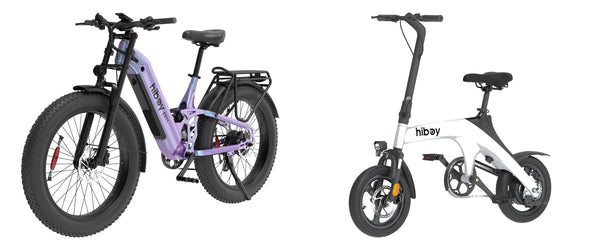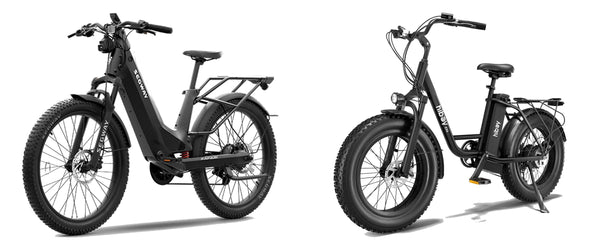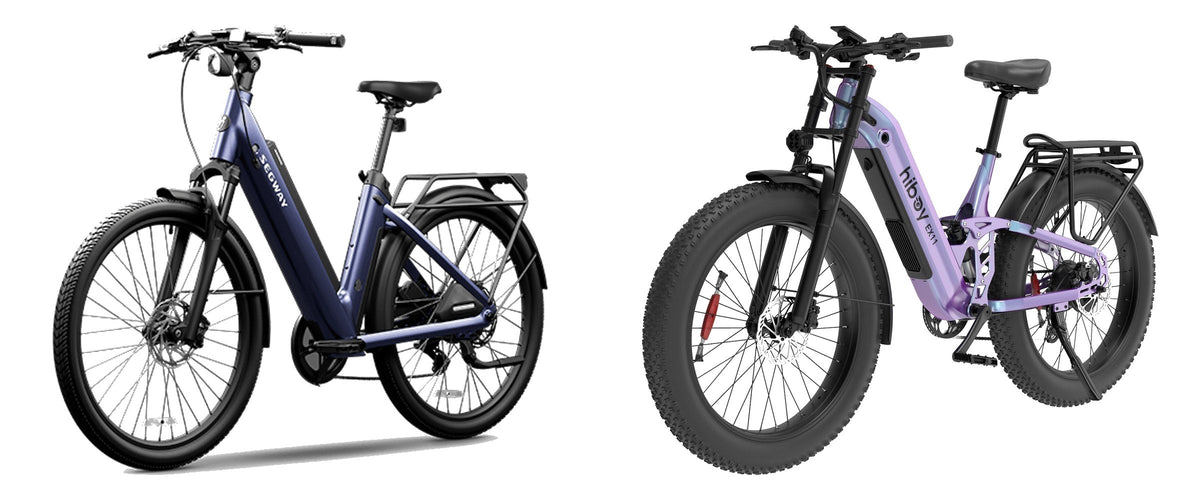


The best e-bike for hills is the Segway Myon: 85 Nm of torque, a torque sensor, and automatic 9-speed Shimano Cues shifting that uses an incline sensor to pick the gear and add power as the road tilts up. If you want the most torque, the Hiboy EX11 makes 90 Nm. If you stop and start on steep streets with a load, the Segway MUXI holds itself on a slope with Hill Start Assist. Every pick is an e-bike we sell and service.
Watts get the headlines, but on a hill the numbers that matter are torque (in newton-metres, Nm), how the e-bike senses your pedaling, and whether it has gears to keep your legs and the motor in their comfortable range. This guide picks from our e-bikes on those three things, using the makers' own figures.
The best e-bikes for hills at a glance
| E-bike | Torque | Motor | Sensor | Gears | Rated climb | Price band* |
|---|---|---|---|---|---|---|
| Segway Myon | 85 Nm | 500W, 1500W peak | Torque, speed, cadence, incline | Shimano Cues 9-speed, auto | Not listed | $1,000–$2,000 |
| Hiboy EX11 | 90 Nm | 750W, 880W peak | Torque | Shimano 1x7 | 20% | $1,000–$1,500 |
| Segway MUXI | 85 Nm | 750W direct drive, 1500W peak | Not listed | Single speed | Not listed | $1,000–$2,000 |
| AOTOS Flux X26 | 80 Nm | 750W, 1200W Boost | Not listed | Not listed | 25% | $1,500–$2,000 |
| Segway Xafari | 80 Nm | 750W | Torque and gyroscope | Not listed | Not listed | $1,000–$1,500 |
| Hiboy EX9 | Not listed | 750W, 1000W peak | Dual-sided torque | Not listed | 20% | $1,000–$1,500 |
| Hiboy EX6 | Not listed | 500W, 960W peak | Not listed | Shimano 7-speed | 20% | $500–$1,000 |
*Price band from our current price; the product page shows today's price. Specifications are the makers' own, from our product pages; "not listed" means the maker doesn't publish it. E-bikes with a motor of 750 watts or more, or able to provide motor assistance at 25 mph or more, aren't sold or shipped to New York City addresses.
Best e-bike for hills: Segway Myon
The Segway Myon is the easiest e-bike in this guide to ride up a hill without thinking about it. Speed, cadence and incline sensors feed Segway's algorithm, which shifts the Shimano Cues 9-speed for you, and the Myon senses inclines and adds torque as the climb starts. A torque sensor matches the assist to how hard you push. The motor is rated 500W with 1500W peak and 85 Nm, and Segway two-piston hydraulic disc brakes with 180 mm rotors handle the way back down. The 722 Wh battery is rated for up to 80 miles. You can still shift manually at the touch of a button.
Most torque: Hiboy EX11
The Hiboy EX11 has the highest torque figure in this guide, 90 Nm, from a 750W motor (880W peak) with a torque sensor. Hiboy rate it for a 20% grade. A Shimano 1x7 drivetrain, an 80 mm dual-crown fork and 4-link rear suspension keep the 26 x 4.0 inch fat tires gripping on loose climbs, and dual-piston hydraulic brakes with 180 mm rotors control descents. The 864 Wh removable battery is rated for up to 100 miles with pedal assist, which helps, because hills use battery fast. It weighs 99.2 lb, so it is a climber, not something to carry upstairs.
Best for steep stop-and-go: Segway MUXI
The Segway MUXI is built for hilly streets with a load. Hill Start Assist holds it still when you stop on a slope until you move off, Hill Descent Control lets the motor regulate speed on the way down so the brakes stay cool, and Traction Control helps on wet or loose ground. Its 750W direct-drive hub makes 85 Nm (1500W peak) on a single-speed drivetrain, so the motor does the work rather than the gears. It carries 419 lb in total. The MUXI Pro adds a 9-speed with electronic auto shifting and the same hill assists. More in our Segway MUXI guide.
Steepest rated climb: AOTOS Flux X26
AOTOS rate the AOTOS Flux X26 for a 25% grade, the steepest rated climb among the e-bikes here. Its 750W rear motor makes 80 Nm, with a Boost mode that delivers 1200W peak for up to 10 seconds at a time, useful for the steepest pitch of a hill. It rolls on 20 x 4.0 inch fat tires with front and rear hydraulic suspension and front and rear hydraulic disc brakes, and the 864 Wh battery is rated for up to 50 miles.
Best value for hills: Hiboy EX9 and Segway Xafari
The Hiboy EX9 pairs a 750W motor (1000W peak) with a dual-sided bottom bracket torque sensor, so the assist rises as you push harder on a climb. Hiboy rate it for a 20% grade, and front and rear hydraulic disc brakes cut the motor when you brake. The Segway Xafari makes 80 Nm from 750W, with 12 assist levels regulated by torque and gyroscope sensors; Segway quote 30 percent faster acceleration on the biggest climbs. See our Segway Xafari guide.
Under $1,000: Hiboy EX6
The Hiboy EX6 is rated for a 20% grade with a 500W brushless motor (960W peak) and a Shimano 7-speed, so you can drop a gear and help the motor on a long climb. Its removable 48V 14.5Ah battery is rated for up to 75 miles with pedal assist. More options in best electric bikes.
What makes an e-bike good on hills
- Torque first. Newton-metres tell you how hard the motor pulls at low speed, which is what a hill needs. The picks that list it run from 80 to 90 Nm.
- A torque sensor. It reads how hard you press the pedals and adds power in proportion, so climbing feels natural instead of on-off.
- Gears. Gears keep your cadence and the motor in their efficient range. Auto shifting (Myon, MUXI Pro) does it for you.
- Brakes for the way down. Hydraulic discs with larger rotors stay strong on long descents.
- Battery. Climbing uses much more energy than flat riding, so expect less than the rated range in hilly areas. See how far an e-bike can go.
- Class rules. Assist stops at 20 mph (Class 1 and 2) or 28 mph (Class 3), uphill or not. See e-bike classes explained.
Service for hill riders
Hills wear brakes, chains and drivetrains faster. Our technicians service every brand at all six Wilson's shops, wherever you bought it, with express service at every location. Starting prices with parts and labor included:
- Brake repair: from $25 · hydraulic brake bleed: from $15
- Chain and drivetrain replacement: from $45
- Derailleur and hanger alignment: from $40
- Pedal assist and torque sensor repair: from $35
- Motor repair (hub and mid-drive): from $100
Looking it over and telling you what we find is always free. See e-bike repair or e-bike chain and drivetrain repair.
Frequently asked questions
What is the best e-bike for steep hills?
The Segway Myon for most riders: 85 Nm, a torque sensor and automatic shifting that reacts to the incline. The Hiboy EX11 has the most torque (90 Nm), and the AOTOS Flux X26 the steepest rated climb (25%).
How much torque does an e-bike need for hills?
More is easier. The hill picks here make 80 to 90 Nm where the maker lists it. Gearing and a torque sensor matter too.
Is a torque sensor better for hills?
Yes, for most riders. It adds power in proportion to how hard you pedal, so you get the most help exactly when the hill gets steep.
Do I need gears on an e-bike for hills?
Gears help a lot on long climbs. A single-speed e-bike like the MUXI relies on a strong motor instead.
Where can I buy one?
Order online with free shipping to the lower 48, or ask about availability at any Wilson's shop. You can pay over time with Affirm at checkout; see financing. For electric scooters, see best electric scooters for hills.
Sources: makers' specifications as listed on our product pages for the Segway Myon, MUXI, MUXI Pro and Xafari, Hiboy EX11, EX9 and EX6, and AOTOS Flux X26, read November 2026. Repair prices are Wilson's starting prices, parts and labor included.