


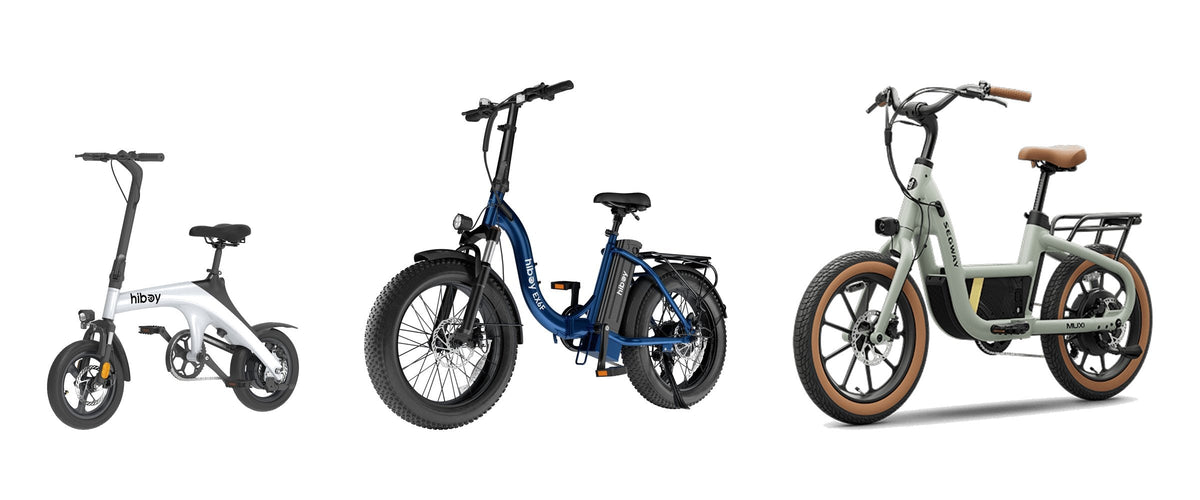
Most adult e-bikes cost between $500 and $2,000. Under $500 buys a basic e-bike with a small battery, gears and disc brakes. From $500 to $1,000 you get a bigger, certified battery, hydraulic brakes and often a folding frame. From $1,000 to $2,000 come torque sensors, full suspension, cargo e-bikes and batteries rated for 80 to 100 miles. Premium e-bikes with mid-drive motors and carbon frames can cost well over $3,000. Running costs are small: a full charge costs well under 50 cents at typical home electricity rates.
Below: what each price band gets you, using the e-bikes we sell as examples, what actually drives the price, what an e-bike costs to own, and how to spread the cost. Prices change often, so we give bands; every product page shows today's price.
E-bike prices at a glance
| Price band* | What you typically get | Examples we sell |
|---|---|---|
| Under $500 | A 350W rated motor, a 36V battery of about 280 to 375 Wh, gears, disc brakes, a front fork; kids' electric balance bikes | KuKirin Victor 4.0, Victor 3.0, Victor 2.0 Pro, Hiboy BK1 |
| $500 to $1,000 | A 500W motor, a removable 48V battery rated for up to 75 miles, UL 2849 certification, hydraulic brakes, fat tires, folding frames | Hiboy EX6F, Hiboy EX6, Hiboy C1 |
| $1,000 to $2,000 | 750W motors, torque sensors, batteries up to 936 Wh rated for 62 to 100 miles, full suspension, cargo frames, automatic shifting, GPS | Segway Myon, Segway MUXI, Segway Xafari, Hiboy EX11, Hiboy EX9, Hiboy P6 |
| $1,000 to $3,000 | Full-suspension fat tire e-bikes for taller and heavier riders, larger battery options | AOTOS Flux X26 |
| Over $3,000 | Mid-drive motors, carbon frames, premium components, mostly from traditional bicycle brands | We service these; see the best e-bike brands |
*Bands from our prices on November 2, 2026; the product page shows today's price. Specs and ranges are the makers' own, from our product pages. Range is rated in good conditions with a light rider; hills, cold, a heavier rider and the throttle cut it.
Under $500: what a cheap e-bike gets you
The KuKirin Victor 4.0 shows what an e-bike under $500 can be: a 350W rated motor with 750W peak, 20 mph, a removable 36V 280.8 Wh battery rated for up to 40 miles with pedal assist, a 7-speed, a front suspension fork and disc brakes at both ends, at 46 lb with a 300 lb max load. The Victor 2.0 Pro moves to an aluminum frame with a 21-speed Shimano derailleur.
What you give up at this price is mostly battery: the Victor 4.0's is about a third the size of the 864 Wh pack on the Hiboy EX11, and you won't find a torque sensor or full suspension. For short, flat rides that is often enough. For kids aged 3 to 5, the Hiboy BK1 electric balance bike (up to 9 mph, 17.64 lb) is also under $500.
Are cheap e-bikes worth it?
A cheap e-bike is worth it when the battery is certified, the brakes match your riding and you can get it serviced. Watch for three things:
- An uncertified battery. Look for UL 2849 (the whole electrical system) or UL 2271 (the battery). New York City only allows the sale of certified e-bikes and batteries; see NYC's battery safety law.
- A rated range you'll never see. Small batteries are rated with a light rider on pedal assist. If your ride is long or hilly, size up.
- No parts or service. Tires, brake pads and chains wear on every e-bike. An e-bike nobody can fix is expensive at any price.
$500 to $1,000: the best value for most riders
This is where e-bikes get much better for not much more money. The Hiboy EX6F has a 500W rated motor (750W peak), a removable 48V 14.5Ah battery that is UL 2849 certified and rated for up to 75 miles with pedal assist, hydraulic disc brakes, a hydraulic front fork, 20 x 4 inch fat tires, a Shimano 7-speed and a low-step frame that folds in three places. The Hiboy EX6 is the non-folding step-through version and carries 300 lb. The Hiboy C1 folds in one piece on 14-inch tires for small apartments, with a 350W motor and up to 26.2 miles.
$1,000 to $2,000: torque sensors, suspension and cargo
Above $1,000 the money goes into how an e-bike rides and what it can carry:
- Torque sensors and automatic shifting. The Segway Myon reads how hard you pedal and shifts its 9 speeds for you, with a 722 Wh UL-certified battery rated for up to 80 miles, hydraulic brakes and GPS with Apple Find My.
- Full suspension. The Hiboy EX11 has a 4-link rear and an 80 mm front fork, 90 Nm and an 864 Wh battery rated for up to 100 miles.
- Cargo. The Segway MUXI carries 419 lb in total, with traction control and hill start assist; the MUXI Pro adds a 9-speed with automatic shifting. Compare them in the best cargo e-bikes.
- Big batteries. The Segway Xafari runs on a 936 Wh battery rated for up to 88 miles.
- Speed for commuting. The Hiboy EX9 is a Class 3 commuter e-bike with a dual-sided torque sensor at 59.5 lb; see e-bike classes explained.
What makes one e-bike cost more than another
- Battery size. Watt-hours (volts x amp-hours) are the biggest single cost and decide range. Compare the Victor 4.0's 280.8 Wh with the EX11's 864 Wh.
- Certification. UL 2849 testing costs makers money, and it's worth paying for.
- Motor and sensor. Hub motors cost less than mid-drives, and cadence sensors cost less than torque sensors, which feel more natural.
- Brakes. Hydraulic disc brakes stop harder with less effort than mechanical ones.
- Suspension and frame. Full suspension, folding frames, cargo frames and lighter alloys or carbon all add cost.
- Extras. Apps, GPS tracking, alarms, integrated lights, racks and automatic shifting.
What an e-bike costs to own
Charging
Charging is cheap. A full charge of a 700 to 900 Wh battery uses roughly 0.7 to 0.9 kWh, which is about 10 to 35 cents at home electricity rates of 15 to 35 cents per kWh. A smaller 280 Wh battery costs a few cents to fill. Check your own rate on your power bill.
Maintenance and repairs
Tires, brake pads and chains are the parts that wear. These are our starting prices, parts and labor included; the final price depends on the model:
| Service | From |
|---|---|
| Simple inspection | Free |
| Tune-up and safety check | $50 |
| Flat tire repair | $40 |
| Brake repair | $25 |
| Hydraulic brake bleed | $15 |
| Chain and drivetrain replacement | $45 |
| Battery load test and health report | $50 |
| Battery replacement | Quoted after the test |
More in what e-bike repair costs. Our technicians service every brand, wherever you bought it, with express service at every shop; see e-bike repair.
Gear, registration and insurance
Budget for a good lock and a helmet, and lights if your e-bike doesn't have them. In most states an e-bike in one of the three classes needs no registration or insurance. New Jersey is the exception we see most: since 2026 every e-bike there is registered, and e-bikes with a throttle must be insured; see New Jersey e-bike laws.
How to spend less on an e-bike
- Pay over time. At checkout you can pay in full or split the price into 4 interest-free payments every 2 weeks with Klarna or Affirm. See financing.
- Buy open box or used. See our used and open-box electric scooters and e-bikes. Buying used elsewhere? Look the model up on the CPSC recalls list and bring it in for a free simple inspection.
- Buy the battery you need, not the biggest. If your round trip is 10 miles, a 75-mile rating is plenty.
- Look after it. Correct tire pressure and a yearly tune-up keep range up and repair bills down.
E-bikes we sell ship to the lower 48, with a one-year Wilson's warranty against manufacturing defects on the brands we carry and 15-day returns (see our refund policy). Browse every electric bike, or compare with what an electric scooter costs.
Never charge a battery that is wet, swollen or damaged, or one that has taken a hard crash hit: bring it straight in.
Frequently asked questions
How much does a good e-bike cost?
For most riders, $500 to $2,000. Between $500 and $1,000 you can get a certified battery rated for up to 75 miles and hydraulic brakes, like the Hiboy EX6F. Between $1,000 and $2,000 you get torque sensors, suspension and cargo e-bikes.
What is the cheapest e-bike worth buying?
One with a certified battery, brakes that suit your riding and parts you can get serviced. Under $500, the KuKirin Victor 4.0 has 750W peak, a 7-speed, front suspension and disc brakes.
Why are e-bikes so expensive?
The battery is the biggest cost, followed by the motor, the brakes and the frame. Certification to UL 2849 also adds cost, and it's the part not to skip.
How much does it cost to charge an e-bike?
About 10 to 35 cents for a full charge of a 700 to 900 Wh battery at home rates of 15 to 35 cents per kWh, and a few cents for a small battery.
How much does e-bike maintenance cost?
At our shops a tune-up and safety check starts at $50, flat tire repair at $40 and brake repair at $25, parts and labor included. A simple inspection is free.
Can I pay for an e-bike in installments?
Yes. At checkout you can split the price into 4 interest-free payments every 2 weeks with Klarna or Affirm, or pay in full by card, PayPal, Shop Pay, Apple Pay or Google Pay.
Sources: our prices and the makers' specifications on our product pages, read November 2, 2026; Wilson's repair price list. Charging cost is calculated from battery size and a range of home electricity rates. General information.


